Monday, June 30, 2014

SECOND HELPINGS: 2001: A Space Odyssey (1968)

This movie is a sort of line in the sand by which you can determine if someone is a casual or hard core sci-fi fan. If you don’t like it, chances are that you mostly just embrace the “exciting” sci-fi films like Star Wars, some Star Trek, and any number of the popcorn sci-fi flicks pumped out by Hollywood each year. If you like 2001: A Space Odyssey, you are okay with the arty side as well and tend to expect more from your sci-fi than the casual fan.

I love this film for a number of reasons, so I am deeply in the hard core sci-fi camp. The blend of science fiction and science fact is dazzling even now. Stanley Kubrick worked with sci-fi legend Arthur C. Clarke to make a realistic yet fantastical tale set in what was then the future. It’s now 2014, we abandoned moon missions long ago, and we don’t have spinning space stations in orbit. But we do have video chat, tablet computers, and dangerously powerful supercomputers.

This brings us to the first part of the beauty of this film- it doesn’t go overboard on imagining the future. Compare 2001’s vision of 33 years into the future with the vision of 2015 in Back to the Future Part II. That film goes for eye candy while 2001’s future looks practical yet advanced enough to look different in several ways. Near-future science fiction is difficult to pull off well, but Kubrick & company nail it.

The themes of the film are also worth noting. At the heart of it all, 2001: A Space Odyssey is about mankind trying to figure out their place in the universe. Mysterious monoliths sending signals from the earth to the moon and from the moon to Jupiter? How can astronauts possibly refrain from investigating where this leads? There is also the struggle between man and technology via the creep-tastic HAL-9000. How close are we getting to that scenario in real life?

Then there are the bold artistic decisions. Dialogue is absent from over half of the film’s runtime. The lengthy ‘Dawn of Man’ sequence at the beginning is sure to cause loss of interest in some viewers and confuse most of the rest. The ending will further frustrate audiences with its seeming randomness and vague resolution.

For me though, it really comes down to execution. From a technical standpoint, 2001: A Space Odyssey is one of the most perfectly made films I have ever seen. I love the use of models in the docking of the spaceship at the space station (metaphor for a courtship dance perhaps?) and the rotating sets are a special effect that blows your mind when you analyze how they were timed to work out the way they did. The details are so fine and so intentional that I find myself in awe of them every time I watch this film.

It looks gorgeous and there is a lot under the hood here. The only reason it doesn’t get my highest rating is that 2001 is somewhat unapproachable for many. Things don’t make much sense until you talk to someone who lives and breathes this movie or if you have read the novelization to understand some of finer points that cannot be handled with in-film exposition (the monolith coaxing the ape to pick up and use the bone). I read the book and it helped me understand the beginning and ending much more. Even I don’t completely understand everything about this film but Kubrick and Clarke intentionally made it hard to digest. I can’t quite tell if that is a negative attribute or sheer genius. For now though, my rating stands as it has for the last 11 years.

Original Rating: 4.5 out of 5

New Rating: 4.5 out of 5

Friday, June 20, 2014

Spice World (1997)


Considering they were the biggest British music phenomenon to take the world by storm since The Beatles, it shouldn’t surprise us that the Spice Girls were commoditized the way they were.  That being said, there really is no excuse for this mess of a film.  It’s obvious that the filmmakers want to emulate A Hard Day’s Night, but it doesn’t take long for the Spice Girls’ tour bus to run into a heaping pile of ‘what the heck just happened?’

The Spice Girls are prepping for a performance at the Royal Albert Hall but the grind of touring wears on them.  They are relentlessly pursued by tabloid snakes, wannabe documentarians, and Hollywood producers looking to cash in on the group’s popularity.  All they want (all they really, really want) to do is get some fresh air and spend time with their pregnant friend.  When their manager tries to prevent them from doing so, the Girls take off, putting their performance at the Hall in limbo.

It’s a shame that concert films weren’t in vogue in 1997 like they are now.  Ninety minutes of actual tour footage and backstage antics would have been far more insightful and interesting.  Instead, we get a rambling day-in-the-life saga full of screwball comedy clichés that wore out their welcome sometime back during the Ford Administration.  The framework is a total rip-off of A Hard Day’s Night (band is stressed, one or more members take off, scramble to get them together for the show) but at least The Beatles had charm. 

In Spice World, audiences are served a lukewarm story that depicts the Spice Girls more or less how everyone but their fans saw them- plastic nitwits who sing corny ballads about 90s ‘girl power.’  As with The Beatles, it is clear that, despite whatever stage presence they may have, none of the Spice Girls can act.  Lines are stiffly and awkwardly read, not delivered.  There is nothing personal or introspective about the script and we cannot even feel sympathy for the girls because no one feels bad for celebrities anymore.

As an American, I can’t help but wonder if Brits got more out of this film than all other nations.  All the random cameos and attempts at cheeky British humor fall flat for us because it’s not done well.  Do Brits appreciate it simply because they tried to tap into some obligatory Brit humor, or do they resent the Spice Girls all the more because it was a calculated attempt to score points with the home team?

These are some of the deepest questions you can expect to draw from this outright train wreck of a film.  Its Generation ADD target audience will soak up the randomness and Crayola-factory-gone-nuclear color pallet, thinking the Spice Girls are so clever.  Fans always forgive, but I am not a fan.  And I will certainly never forgive anyone involved in making this movie.  Run from this one.  Run from it as fast as you can.

RATING: 1 out of 5

Wednesday, June 18, 2014

The Lion King (1994)

Save for a pit stop into the European-esque setting of Beauty and the Beast, Disney continues its use of exotic locales for its animated films. Set in the wilderness of the African grasslands, The Lion King features a tonal shift back towards the dramatic while still maintaining much of the flash and sizzle that early entries to the Disney Renaissance brought to the table. The end result may not go down as smooth for some but this film is undeniable as a spectacle to behold.

A multitude of animals from the Pride Lands gathers to celebrate the birth of a new prince, a lion cub named Simba. The rambunctious cub is watched with glee by many but disdained by his uncle, Scar. The devious villain executes a plot that leaves Simba’s father dead while convincing the young prince that it is his fault. Simba avoids death at the hand of Scar’s minions but runs away in self-imposed exile, full of grief over his father’s death. As Simba grows up, he must confront his fears, question what he came to accept as the truth, and return to his homeland to face his uncle once more.

Disney really shoots for the stars here. The Lion King features some heavyweight dramatic elements, a top-notch crew handling the soundtrack, and some of the best animal animation since Bambi. It all pays off pretty well, but seeing it for the first time in many years leaves me thinking this film is just a wee bit overrated.

Much of the animation is glorious. The colors and textures weaved throughout the foreground and background environments expertly present the African plains. The filmmakers gave Disney’s crew of animators a tall task in creating animal characters that actually move like the real animals do. While I am sure that there are a handful of inaccuracies and inconsistencies here and there, the attention to detail is evident and maintained my suspension of disbelief.

As with other Disney movies of the era, the few instances of CGI-traditional animation fusion (including parts of the signature wildebeest stampede) just don’t do it for me. After mentioning this a few reviews in a row, I have to wonder if this comes from modern CGI animation spoiling us with its realism or if I would have actually noticed and complained about this hybrid style had I been an adult seeing it when it initially came out. Special effects never look as good at home as they do on a large theater screen. That is just a fact.

The music and songs of The Lion King are the stuff of legend. As with Aladdin, there are actually only five songs in the original version of the film (they added a new ditty to the special edition version that I watched but I’m able to look past it). Unlike its predecessor, four of the five songs are terrific and continue to be popular to this day. It’s hard to imagine anything less with such talent involved (Elton John- music, Tim Rice-lyrics, Hans Zimmer- conductor). Only Scar’s tune, “Be Prepared,” lacks staying power, but how many villain songs actually have much popularity with the kids anyway?

Believe it or not, I find the most fault with the characters and the story of this film. Once again, Disney’s dastardly villain is effeminate. Why does Scar, who looks and occasionally acts fierce, have to slink around like the female lions and utter whiny sarcasm with a British accent? Scar and Jafar seem cut from the same cloth- powerful villains watered down with what could be mistaken for stereotypical homosexual qualities and mannerisms. To top it off, his musical number is full of Nazi imagery (goose-stepping hyenas anyone?), which makes the characters as a whole feel somehow disjointed and confusing.

Speaking of the hyenas, I found them to be very creepy; I imagine many small children being terrified of them then and now. They aren’t the only supporting characters that get it wrong for me either. Timon and Pumba, joyfully raucous as they are, flood their scenes with non-contextual humor that doesn’t fit with either the African setting or the serious tone of the rest of the film. Had The Lion King gone for broke with the funny throughout (a la Aladdin), their antics wouldn’t have been as detrimental to my overall rating. When the rest of your film smacks heavily of Hamlet, it’s nice to have some comic relief. But these two go a little overboard at times, as if their existence is to entertain and engage those kids who might be bored with the rest of the film’s adult overtones.

There is a lot going on in this film, which sometimes can be disastrous. Fortunately for Disney and audiences alike, The Lion King walks its tightrope with deft precision. Several pitfalls and traps lie throughout its 88-minute runtime, but it never gets too carried away in its seriousness or its silliness. I can’t fault anyone for thinking this is one of Disney’s greatest films but I will certainly disagree with them. It functions well enough as an epic animated spectacle but, if you look closely, you can see where the gloss and glamour run a little thin.

RATING: 3.75 out of 5

Monday, June 16, 2014

SECOND HELPINGS: Casablanca** (1942)

It seems like every time that I watch this film I understand its popularity more and more. This was one of what I call the Original Eleven- one of the 11 films that I watched in my freshman comp & speech class in college that started my whole movie rating obsession. I did not care for it one bit when I first saw it in the autumn of 2002. Over time, I have come to terms with much of this film, but I still have a few issues with it.

Some films from Casablanca’s era are ridiculously dialogue heavy. I used to wonder if this was a common trait for older films but I found that to not necessarily be the case as I have watched more and more films from the early days of Hollywood. Casablanca certainly fits the mold of reel-to-reel lightning-fast conversation. The conversations between Rick, Ilsa, Victor, and Captain Renault are full of exposition, wit, and a flurry of emotions.

At times, these conversations literally pull you from one point to the next, giving you very little time to digest what is actually being said. If you are fine with taking the film as it comes, then you probably see nothing wrong with any of its content. The more you think about the film afterwards, however, the more you realize its plot elements fall apart in some ways. It’s only an hour and forty minutes long, so there is plenty of room to slow the dialogue down and tighten up a few of the details.

The music of Casablanca is terrific and the acting is very good, but there isn’t much that I found technically exciting about this film. There are a lot of static shots of people talking to each other or cuts back and forth between the faces. I can recall one scene in Rick’s where the use of shadow is quite good but very little else stands out as a unique or memorable shot. There is also a pretty glaring continuity error during the famous airport scene- Major Strasser’s epaulettes appear and disappear between cuts. Oops!

Overall, I get why people love Casablanca. It is full of romanticism, heroism, and idealism set against the dark days of World War II. The cookie cutter bad guys are so mean that it’s hard not to cheer on those who oppose them. I see it as an above-average film with a cult following. I think part of the appeal is generational, as it provided a distraction from the grim realities of World War II when it was released and it was a model for idealism and earnestness for Baby Boomers growing up with its occasional re-release in theaters. I am not part of either generation, so I can easily look past it to find the better films of the era.

Original Rating: 2.5 out of 5

Second Rating: 3 out of 5

New Rating: 3.5 out of 5

Friday, June 13, 2014

The Dark Knight Rises (2012)

Oh, the finality! The themes of Christopher Nolan’s Batman trilogy began with origins (Batman Begins), and ratcheted up with escalation (The Dark Knight). The way the second installment ended, you would have thought that the final chapter would be about redemption and honor. Nah- Nolan cranks things up to 11 with a film rooted firmly in annihilation.

Eight years after the events of The Dark Knight, Bruce Wayne is still plagued by the physical after-effects of moonlighting as Batman. Despite his ailing body, a new evil draws the Caped Crusader from his self-imposed exile. Physically and intellectually gifted, the revolutionary and terrorist known as Bane pushes Batman and Gotham City to their limits. With the city held hostage (literally cut off from the rest of the world), Batman must find a way to defeat his opponent and save Gotham from nuclear holocaust.

As far as final chapters go, this one is a doozy. Just as I appreciated seeing Batman with bruises in Batman Begins, I liked that the filmmakers acknowledged that being Batman comes with irreversible wear and tear. Bruce Wayne is frailer this time around, forcing him to find strength in his mind and in his beliefs in what he fights for. Batman is no longer fighting for justice; now he truly fights for good against Bane’s evil.

Our antagonist, Bane, is a tough egg to crack. He comes across as equal parts bad guy caricature and plausible threat. His eloquent rants about liberation from class structure and the greed of Gotham’s elite smack of Occupy Wall Street and extremist liberal revolutionaries. He seems well-versed in the likes of Marx and Hitler, attracting the disenfranchised from the shadows like the pied piper. With Bane in charge, the have-nots and the mentally unstable take over.

Bane’s followers don’t seem to mind his almost Orwellian police state, nor do they seem bothered by his countdown to oblivion. Perhaps they don’t believe their hero would liberate them for a few months only to destroy them. Or perhaps they are too caught up with their revenge against the haves via kangaroo court to notice that the light at the end of their tunnel is actually an oncoming train. Either way, it all feels possible and that should scare the heck out of all of us.

The realism of post-revolution Gotham never fully sinks in because director Christopher Nolan knows he has to deliver some spectacle. With the stakes as high as they are, the action is grander, the gadgets are fiercer, and the drama strives to be epic in scope. Unfortunately, converging all of the plot lines for the grand finale requires too many doses of convenient timing and lucky coincidence for me to swallow. I can appreciate red herrings and slight-of-hand, but The Dark Knight Rises goes too far at times for me to suspend my disbelief.

Fanboys currently have The Dark Knight Rises at #50 on IMDB’s Top 250 movies list. I am not a fanboy. I enjoy this film on its own and as the final chapter in the recent Batman trilogy. I like the way the filmmakers incorporated Selina Kyle into the mix (though she is never actually called Catwoman). I even appreciate the character of Bane, difficult as he is to understand at times. But this is weakest of the three Nolan Batman films. The pace is uneven and its big ideas get crowded out in favor of action/comic book movie staples.

The Dark Knight Rises works, but we want to triumph with our heroes (especially comic book heroes). With this film, audiences achieve catharsis. Maybe we should just be glad that this film wasn’t a major letdown, as many sequels are. Maybe this is what the filmmakers wanted our mindsets to be heading into this movie. If you keep expectations low enough, you are never disappointed. I expected a quality product and that is more or less what I got. It probably wasn’t possible to top The Dark Knight but I was hoping for an equal to Batman Begins.

RATING: 3.5 out of 5

Wednesday, June 11, 2014

SECOND HELPINGS: The Dark Knight (2008)

Not much has changed since my original assessment of this film, though I don’t feel the need to be as wordy this time around. My original review for this film is probably one of the worst I’ve ever written because it rambled. This second go around will be much more terse and to the point.

What’s still good about this film? I like the move away from a comic-book accented Gotham City. Gotham looks like a real major city, making the carnage and terror unleashed by the Joker seem more palpable. I also still enjoy the theme of escalation and how Bruce Wayne is troubled by it. He has to reckon with the Joker’s rules of engagement without losing too much of himself. Heady stuff for a comic book flick.

And of course, Heath Ledger steals the show as the Joker. I cannot praise the decision enough to keep the character as an enigma. In this politically correct era of trying to understand bad guys, The Dark Knight’s Joker is a breath of fresh air. There can be no justification for his antisocial tendencies or his sociopathic nature, so none is given. Sometimes you have to accept evil as evil, and the late Heath Ledger goes all out to embody an almost perfect evil.

What still doesn’t work for this film? It is more than just a little unbelievable for the Joker to plan so far ahead for some of the things he does. Anything that he does not seem to have a contingency plan for goes perfectly for him out of sheer luck or coincidence. If you stop and think about it all after the credits roll, one or two strokes of luck the other way would have cut this film short in any number of places.

There is no denying the power of Heath Ledger's performance though. Christian Bale does some fine work as well but the success of Batman films are usually determined by the villain. Fortunately for everyone involved, this version of the Joker is the best Batman film villain to date. There is not enough ludicrousness in the Joker’s ability to plan to undermine The Dark Knight’s strengths. My original rating stands because you can pick this movie apart if you really want to get down to brass tacks.

Original Rating: 4 out of 5

New Rating: 4 out of 5

Monday, June 9, 2014

SECOND HELPINGS: Batman Begins (2005)

Like a fair number of people, I went nuts for this movie when it first came out. Here was a Batman that is at least somewhat plausible, unlike the Tim Burton and Joel Schumacher films of the 80s and 90s. The characters have depth and struggle with heavy-hitting themes without being paraded around as pure spectacle and an excuse for overacting supporting characters. I watched this film again before seeing The Dark Knight Rises and some of its flaws became more apparent.

Maybe it is a direct result of seeing its successors so soon after taking this film in, but Batman Begins feels the most out of place of Christopher Nolan’s trilogy. It feels the most like a comic book movie of the three and the layout, look, and feel of parts of Gotham City give off a slight comic book vibe. The other two do not. Gotham feels more like a real city. I don’t want to let a criticism of continuity for the whole trilogy affect my rating for this film, so I am hoping that my initial enthusiasm was a matter of me being dazzled by the breath of fresh air that was Batman Begins.

I am fine with the League of Shadows. In fact, it makes for a very worthy foe. Batman is forced to go head to head with the forces that trained him. Their motive for destroying Gotham is fascinating but their intended means of accomplishing their goal lacks some believability. The water-vaporizing weapon goes just a little far out there, considering how realistic much of the rest of the film is.

Batman Begins marked an exciting new direction for not only Batman but for superhero movies in general. It showed that you can tone down the flamboyant elements of the comic book genre and still create something exciting. To make it a powerful emotional and intellectual draw is an added bonus. The framework of these pros can easily be attributed to the X-Men franchise but Batman Begins benefits from a better balance of flair and fun, while also focusing on far fewer characters. For this, I still hold it to be an excellent film but I feel I have to drop it ever so slightly from the ranks ‘great’ films.

Original Rating: 4 out of 5 (Click here for the original review)

New Rating: 3.75 out of 5

Friday, June 6, 2014

Because I Said So (2007)

I am going to break from my usual formula for reviews and advise you right off the bat- spare yourself and avoid this movie at all costs. It’s not the worst movie ever made but you will suffer for your foolishness if you decide to watch it. That’s not a threat from me to you. This movie just might make you hate yourself a little bit for subjecting yourself to its inadequacies.

Daphne (Diane Keaton) is a helicopter mom from hell with a fashion sense that never evolved past the Annie Hall mannish look. Latching onto the love life of her youngest daughter, Milly (Mandy Moore), turns out to be a disaster for all parties. Milly ends up dating two men at once- the man her mother favors after placing a personal ad on behalf of Milly, and a musician who Daphne feels is woefully inadequate for her little girl.

Do any of these characters sound likeable to you? A neurotic middle-aged woman who tries to manipulate her adult children? A young adult who ends up sleeping with two men because she can’t figure out which one she really wants to date? Anybody? Anybody? Bueller? Bueller?

To be fair, a story about family member fixing the problems of either one of these characters might have potential. Mixing the two the way the filmmakers have here creates a disaster of a film that fails in every arena save for having a few ideas that might work. The time and cost involved in re-writing this mess into two coherent tales would be enormous because the only two round characters in the current narrative suck big time. Fleshing out the rest of the cast would be a nightmare too because there is very little to work with.

This film is billed as a romantic comedy. There is nothing romantic about a loose woman leading on two decent guys, nor is there anything comedic about the ditzy female stereotypes running amok in these reels. I would expect any intelligent woman to be extremely disappointed with this film. I would also expect any intelligent man to be extremely disappointed with the woman who was tricked into thinking this dreck might be enjoyable.

Some films leave you anxious for resolution. Because I Said So had me anxious for the closing credits. In case you ever had any curiosity in watching this film, please know this: it stinks to high heaven. If you find a copy of it, run in the opposite direction.

RATING: 1 out of 5

Wednesday, June 4, 2014

Friday the 13th: A New Beginning (1985)

Just when you thought the Friday the 13th series had ended on an upswing, here comes a head-scratching misfire that holds a scant few good ideas and a whole lot of poor execution. While it may indeed deliver a new beginning by not bringing Jason Voorhees back to life, that’s about as new or as fresh as it gets. The rest of the film features the same tired, formulaic goings-on as the other Friday flicks.

Several years after murdering Jason Voorhees, Tommy Jarvis still has visions of the masked maniac coming to get him. After bouncing around between psych wards he lands at Pinehurst Halfway House, a middle-of-nowhere facility for troubled teens to rehabilitate their emotional issues. When one resident brutally kills another, someone else starts killing the remaining residents and workers of Pinehurst and its surrounding neighbors. Tommy’s visions of Jason get worse, leading us to wonder if he’s finally snapped and responsible for the killings or if he is being set up.

I recall seeing a portion of this film on TV once when I was in either middle or high school. It didn’t make sense to me then and that assessment hasn’t changed much over time. The horror genre is built upon fake-outs and misdirection, but these foundational elements seem tedious now as they are presented in the series. I can only stomach so many bad decisions and scary moments revealed to be red herrings or dreams before I lose interest. After seeing these tools abused through four movies so far, I have little interest remaining to lose.

The problems with this film are numerous, but really, they are par for the course with Friday the 13th flicks. Disposable teenagers? Yes- and this time they’re all like the bad kids everyone hated in school, so audiences are almost encouraged to cheer on their deaths. Immoral behavior? Oh my yes- sex, drugs, and even trespassing! This film also includes plenty of 80s character stereotypes and embarrassing amounts of generalizations about African Americans and special-needs individuals. The setting feels unnatural and, for my tastes, there is way too much swearing going on. The filmmakers knew it would get a hard-R rating so they clearly are swinging for the fences on obscenity.

I like the concept of bringing Tommy Jarvis back and pushing him to the edge of sanity with all the murders, but this plot thread really didn’t need to occur in a Friday the 13th film. It is an interesting stand-alone concept forced into the framework of a bad movie series. We’re shown early on that the killer cannot be Tommy but we’re still fed the possibility that it might be him the rest of the way through the movie via the concerns of other characters. So much misdirection surrounds the reveal of the real killer but it becomes apparent who the real killer is just a few minutes before the big reveal. The motive comes out of nowhere and couldn’t possibly have been inferred from the events of the film, making it a final-reel revelation that’s the stuff of pulp fiction and amateur mystery writers.

Friday the 13th: A New Beginning is a lot like the first Friday and The Final Chapter. It’s got a few interesting ideas but the execution fails miserably. The two chief things this film has going against is the fact that I felt cheated out of a crappy but tolerable conclusion in Final Chapter, and that there is too much stupidity, absurdity, and randomness in this film’s ingredients for me to rate it any higher. Pulling back the finality of The Final Chapter is a misstep in and of itself. Instead of a fresh start, audiences are most likely wishing for Jason’s return after A New Beginning, which ends with more than enough room for more sequels. God help us all.

RATING: 0.5 out of 5

Monday, June 2, 2014

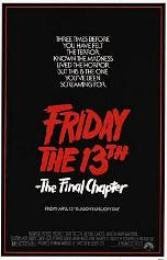
SECOND HELPINGS: Friday the 13th: The Final Chapter (1984)

After three bloody slaughter-fests, this was to be the final Friday the 13th movie. While we know now that this was a big fat lie, you have to wonder what moviegoers anticipated leading up to its release. Would Jason go out in a blaze of glory? How will it all end? Will Jason finally die? Hardcore fans of the series were probably eager for this film and were likely disappointed, while everyone else who thought it would be little more than the same old Friday shenanigans may have found themselves pleasantly surprised.

After a weird greatest hits kind of montage of clips from the first three films, we pick up where Part III left off. Jason, thought to be dead, escapes from a hospital morgue and makes his way back to Crystal Lake. Somewhere on the lake, the newly divorced Mrs. Jarvis moves into her lakefront cottage with her teenage daughter Trish and her young son Tommy (Corey Feldman). A bunch of rowdy teenagers move into the cabin next door for a week of unsupervised fun. All of them lie in Jason’s path, leading to yet another round of blood-letting.

This film made me ponder some very important questions: How does Jason find his way back to Crystal Lake? Why can’t anyone hear this large, lumbering maniac until he is right on top of them? How is he able to break into buildings so quietly? Why are all the girls who visit Crystal Lake opposed to wearing bras?

Once again, we have a bevy of horny teenagers incapable of making good decisions. Sadly, very few of them get memorable or unique executions, something that the first three installments prided themselves on. Despite a lack of flair in his killing technique, Jason actually shows signs of planning his actions and even, dare I say it, comes off as a cunning villain at times. That certainly sets it apart from Jason’s first two rounds.

Other positive points include characters we actually care about. The Jarvis’s are innocent bystanders just trying to make it as a family; they aren’t your typical horror flick fodder. There is also a subplot involving a man hunting for Jason in the hopes of exacting revenge for his sister’s death in Part II. It falls apart a little when you realize that The Final Chapter takes place no more than four days after Part II, but it’s still a nice idea. Then there is also a virgin girl among the rowdy teens. She is the only level-headed one in the bunch. Sadly, most of these likeable characters don’t make it through the film for one reason or another.

Other than a few random acts of decent cinematography, The Final Chapter is more of the same. It doesn’t bring anything full circle or provide any kind of emotional closure one might expect from a final installment. Instead, we get a loose ending that suggests that, while Jason does die, another might step into his shoes. Sure enough, the joke is on us, since this movie made enough money for Hollywood to renege on that whole Final part.

The Final Friday is a step up from both Part II and III, but considering how insipid those two films were, being a step up isn’t really saying much. I have yet to see all of the Friday the 13th movies, but I surmise that this is probably the best place to stop watching the series if you absolutely have to go beyond the original.

ORIGINAL RATING: 1 out of 5

NEW RATING: 1 out of 5