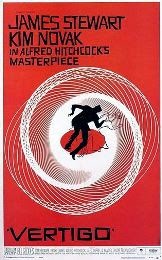
There is something pleasing about watching a master at work. I originally rated this film back when I was in college. Re-watching it all these years later with my wife (who hadn’t seen it before) was a real treat. A modern comparison would be watching The Sixth Sense with someone who doesn’t know what’s coming. But that doesn’t do Vertigo any justice.
Because of how much time had passed between viewings, I had forgotten so many of the nuances that keep this film interesting. Vertigo is a film that creeps along its winding path at a slow but steady pace. There are very few of the ‘gotcha’ moments that fill contemporary suspense thrillers. In fact, Vertigo is almost purely suspense. The thrill comes at the end when you realize what you just experienced.
Hitchcock peppers his film with just enough peculiarity to prevent audiences from slipping into boredom. As events play out, you can’t help but wish things would move along quicker but at the same time you are engrossed by all the details that might be important. In the first half, you are constantly caught off guard by what comes next. The build-up is just so strange that it transfixes you. By the time we reach the mid-film climax, you are locked in and fully invested whatever the second half may bring.
Oh does the second half bring it! The audience is cast back into the murkiness of little details but without as much misdirection. Another revelation lets the audience in on a secret that tantalizes us as we wait for our protagonist to catch on. It’s emotionally and psychologically taxing, leaving us feeling almost as harried as the characters on screen.
I have admired James Stewart’s acting since I started taking movies seriously. He has always been such a believable presence on screen and that is very much the case in Vertigo. As an everyman ex-cop, audiences connect with Stewart because his reactions feel so genuine. His confusion, apprehension, nervousness, and frustration all echo what audiences feel while watching the film.
We don’t just watch the events of Vertigo; we experience them as if we were alongside Stewart. That kind of connection is rare and powerful. It is a doozy of a film that slowly ratchets up the tension while putting pieces together rather than yanking you from one frenetic scenario to the next. This is old-school suspense and it is a beautiful thing.
Original Rating: 4.5 out of 5
New Rating: 4.5 out of 5
Showing posts with label James Stewart. Show all posts
Monday, August 18, 2014
Tuesday, January 17, 2012
You Can't Take It with You** (1938)
Nowadays, the ‘when worlds collide’ comedy setup has all but lost its luster. It’s been played out in just about every possible permutation across just about every demographic group. While this now-tired film convention has made many a moviegoer cynical and detached from the antic within the reels, there’s a magic present in its early incarnations that still manages to bring a smile to faces everywhere. Such is the case with You Can’t Take It with You.Alice Sycamore (Jean Arthur) is madly in love with her employer’s son, Tony Kirby (James Stewart). Tony reciprocates her feelings and their world is hunky dory. The only snag is that they come from two very different families. The rest of the Sycamore clan, and their live-in friends, are nothing less than eccentric. Tony’s family is a bunch of stiff, well-to-do elitists who don’t believe in marrying below their privileged station in life. Sparks fly and hilarity ensues when the Sycamore’s and the Kirby’s finally meet.
I don’t think I’ve been disappointed yet by a Jimmy Stewart film. He and Jean Arthur are simply adorable in this film. They share the kind of chemistry that Hollywood classics are made of. Arthur’s relationship with her bizarro family is equally seamless. The film could probably use a little more interaction between the easy-going Tony and his highbrow parents. Is he as whimsical around his folks as he is around Alice? If so, the shock value of the Sycamore’s wouldn’t be as exaggerated as it is, though it would certainly raise the eyebrows of just about any parent.
As enjoyable as this film may be, the word ‘adorable’ keeps popping into my mind. It applies easily to many aspects of the film: Alice’s Grandpa (Lionel Barrymore) and his simplistic worldview, the optimism of the Sycamore clan, the love between Tony and Alice, the trajectory of the film itself even works in adorable ways. That creates a problem for me. Great films go beyond adorable.
I can’t tell if it’s the jadedness that comes from being exposed to these polar opposites coming together kinds of tales or if it’s the lack of much technical whizbangery that holds this film back for me. I’d like to say the latter but the former is always a possibility. In many ways, my generation is blessed and cursed with the period of films we grew up on. We’re blessed by ever-increasing technical advancements but we’re cursed because everything we’ve grown up watching is in some way derivative of films no one really watches anymore.
Fortunately, quaint films like You Can’t Take It with You remind us that the Hollywood hits of today have a solid foundation underneath them. I won’t make any promises as to how much you may laugh at this classic comedy (let’s face it, some of you out there are so cynical it’s scary!) but I can say with some confidence that this film will, at the very least, make you smile. Even if you try to thwart me by remaining as stern as possible throughout it, I think the charm and magic of this film will finds a way to win you over.
RATING: 3.75 out of 5
Wednesday, August 8, 2007
The Philadelphia Story* (1940)
I don’t find Katherine Hepburn attractive, so it’s hard to watch her in films where she is a romantic lead. This is an early romantic comedy, a genre which was quite popular in the early days of film. Light-hearted, goofy tales that would leave an audience perked up a bit was essential during the 30s, as America struggled to get through the Great Depression. While I can acknowledge the wit and humor in The Philadelphia Story, I thought it was on the boring side.Again, as happens when watching old films, there was a nagging sense that I had seen this sort of thing before. With her wedding day fast approaching, Hepburn is bombarded by other would-be suitors, including her ex-husband (Cary Grant) and a magazine reporter (Jimmy Stewart). Hilarity is supposed to ensue when she starts wondering whether she wants to marry who she’s supposed to and all sorts of wrong perceptions lead us to her ultimate decision.
Perhaps the film is dated, and perhaps it’s just because I’ve seen too much that is similar (in terms of the comedy, not so much the plot). Whatever it is, it kept me from caring too much about The Philadelphia Story. A good “classic” comedy, but not my cup of tea.
RATING: 3 out of 5
Thursday, July 19, 2007
Rear Window (1954)
Sadly, I think the cultural consciousness of this film has resulted in what seems like a low rating. Hitchcock is nothing short of amazing, but with all the references to Rear Window in TV and other movies, it just didn’t hold me like it was supposed to.Perhaps I need to watch it again, but knowing the ending without ever seeing the film really kills the momentum it tries to build throughout. Jimmy Stewart is terrific as always, playing a wheelchair bound photographer stuck in his apartment until he has his leg cast removed. It’s an interesting setup that allows him to spy on his neighbors for lack of anything better to do. Without the injury, he’d simply seem nosey and rude.
Most of the suspense and intrigue comes from what we see through Stewart’s telephoto lens. We can only really see what’s going on, leaving us as clueless as Stewart himself. His paranoid ponderings ask our questions for us and his suspicions launch us into a furor. At least they were meant to. Like I said, the cultural consciousness of the film has all but hampered its intention to thrill us.
All in all, a terrific piece of work.
RATING: 3.5 out of 5
Subscribe to:
Posts (Atom)
