Walt Disney’s second full length animated feature film is full of surprises. Firstly, it is surprising to see a story of Italian origin depict Italians in a rather harsh way. Perhaps this is because of tensions of Italian allegiance to Germany during the time period. Whatever the reason, if you look closely, you’ll find that the good guys in Pinocchio (Geppetto, Pinocchio and the blue fairy) are all fair skinned, more closely resembling Western European and American whites. In contrast, Stromboli, the villainous puppet maker looks and acts stereotypically, with darker skin and sharp gestures. It’s almost as if Disney was playing to “whiter” audiences’ prejudices.
Another unique aspect of Pinocchio is how dark it is. Essentially a morality tale of how to be a good and proper child, there is no romance and plenty of bleakness through most of the film. The beginning and the end are the joyful high points, while hope seems barely a glimmer through the middle. It creates a very down-trodden feel, but not quite to the point of hopelessness.
Despite not being as cheery overall as Snow White, Pinocchio is still a marvel for the eyes. Rich backgrounds and fabulous colors are everywhere, showcasing Disney’s complete and utter mastery for the art form. It’s truly mind-boggling how much detail Disney puts into the background elements. Later animation styles would try and skim these out, creating a more bare-bones feel, but the lushness of the stories Disney chose to animate early on really need all the little details in the background.
Oddly discomforting, yet spellbinding just the same, Pinocchio is another must-see classic from Disney.
It’s a rare treat to find a film about historical events that parallels modern times without seeming arrogant and egotistical about it. A diamond in the rough has surely been found with Good Night, and Good Luck.
Director George Clooney wants you to see the parallel between the McCarthy era witch hunt for communists and the post-9/11 era witch hunt against anyone voicing dissent against the government, branding them “unpatriotic.” However, I got the sense that, as bad as Clooney wants viewers to see the parallel, he doesn’t go overboard. If you don’t pick it up, you’re still going to get a strong idea about the tenacity and vileness of Senator Joseph McCarthy’s tactics. It seems Clooney figures that if you can’t infer the parallel, you’ll at least get a history lesson, hopefully preventing us from sliding into repeating this awful past. It’s a good stance to take.
It’s not preachy and it’s not simplistic. The film is shot in glorious black and white, allowing some of the best use of contrast I’ve ever seen. The blacks are deeply black and the whites and lights stand out against them like a full moon against the night sky. This all works to Clooney’s benefit. The story motors right along and doesn’t really leave you with a traditional ending. Not everything is resolved picture perfect, but that’s life, and the struggle goes on to this day.
Memorably written and expertly shot, George Clooney continues to win me over. While this would have been a controversial pick for Best Picture, I actually think it was more deserving than Crash.
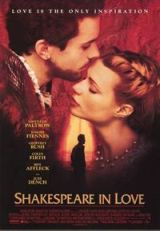
Plain and simple, there are too many fruitballs in the Academy. There is no reason for this movie to have won Best Picture over Saving Private Ryan, one of the most gripping, moving and emotionally jarring films ever made. Instead of choosing a clearly superior film loosely based on a true story full of bravery during one of mankind’s most horrific hours, the Academy decides to honor a piece of pure fiction taking place in an idealized vision of the Renaissance, filled to the brim with historical inaccuracies. And pleather.
Of course, Shakespeare in Love isn’t trying to be accurate in anything it does, which, I guess, is the beauty of it. Just like theatre, the film is flooded with convenience and the use of deus ex machina. There’s plenty of ham to go with the overabundance of cheese as well.
Instead of the drab garb of a repressed middle and lower class, the streets are filled with vibrant colors and fabrics that may or may not have existed back then. The Bohemian lifestyle of living for love despite wretched conditions is perpetuated and glorified in an all too unrealistic way here, and the Renaissance period is whitewashed, where even the potential of plague and illness don’t muck up the fluffy white clouds on the horizon for our characters.
But don’t get me wrong. For what it is, Shakespeare in Love is a solidly good film. It’s exactly the kind of thing its audience is looking for- a fictitious love story set up ambiguously during real events (a la Titanic and Pearl Harbor) with all the frills of a fancy theatre fruitball jolly-fest. And for delivering what the audience wants, it’s a good film. Good costuming and some good camerawork too, which is why it has such a good rating.
As far as my personal tastes go, this one is a dud. But, since I try and keep things in a cinematic perspective, I’ve got to give credit where credit is due, even though the thought of Shakespeare in pleather gives me the chills.
Sort of a West Coast version of To Kill a Mocking Bird, Snow Falling on Cedars focuses on the Washington State trial of a man of Japanese descent during the early 1950s, when Americans (particularly on the West Coast) were fearful and mistrusting of anything Japanese since World War II. The stage is set pretty clearly and the odds are stacked against him.
Ethan Hawke is the town newspaper editor who struggles with his own bias while covering the case. As a boy he was in love with a girl who became the accused man’s wife but he lost an arm fighting the Japanese in the war. Now he finds himself convinced that the accused is innocent and must work against the town’s racism in order for justice to be upheld.
A bit slow from time to time, this film doesn’t quite have the back-story and side plots that made To Kill a Mocking Bird work, but the rigorous pursuit of justice is worth noting. It also doesn’t help much that the film's cast is made up almost entirely of actors known for their supporting roles. Otherwise, it’s a pretty good underachiever.
One of the greatest comedies of all time and one of Mel Brooks’ greatest films, Blazing Saddles uncompromisingly lampoons the living daylights out of the Western genre.
In order to complete a railroad, a corrupt politician decides to scare a whole town into moving. When gangs and thugs don’t work, they try sending a black sheriff to town and get people to leave based on their unabashed racism. That doesn’t quite work either, as the sheriff is a hit and he gets a zany gunslinger of a partner (Gene Wilder) in defending the town.
Blazing Saddles pretty much covers the entire gamut of all things crude, rude and lewd. Cheap shots are made at all kinds of prejudiced beliefs and the absurdities of Westerns in general. Mel Brooks creates one gut-buster of a comedy that is a must-see, no matter how prudish you may be. Unless you’re a super stick in the mud, you’ll find plenty to laugh at here.
I hadn’t seen this movie in quite a while- it took babysitting my younger cousins for me to break it out and give it a review, and I’m glad I did. Honey, I Shrunk the Kids was one of my favorite movies as a child and after seeing it I would wonder what certain things would look like if I were very tiny. I would also look for people in my Froot Loops and Cheerios, but that’s just because I’m a nerd.
Combining some pretty good special effects and a seriously devoted art department, this movie has some really impressive scenery. Sure, some of it looks kind of fake, but for the most part they did a really good job. You actually believe that these kids have been shrunk because their surroundings are so convincing. This is most certainly the essential component to making a film like this work.
A wacky scientist creates a machine capable of shrinking things, but it doesn’t work right very often. The few times that it does work, it shrinks his children and the neighbor kids, who end up having to hike back to the house through the back yard after accidentally being swept up and taken out with the trash.
Targeted for kids but also enjoyable for adults, you’re able to suspend your disbelief at some of the absurdities that would have been more stinging had this movie not meant to be a funny romp in the back yard. Kids will enjoy the adventure and parents will get the message about spending time with your kids. While not perfect, this fun piece of nostalgia is certainly an in-the-park home run.
The hype surrounding this film turned out to be just a whole bunch of jerks online making fun of it, few of whom put their money where their mouths were. But had they gone to see Snakes on a Plane, they’d have been pleasantly surprised.
This film is the ultimate example of truth in advertising- It says it has snakes on a plane, and it delivers snakes on a plane. It doesn’t promise viewers a rousing drama filled with tension and believable characters. It doesn’t promise viewers side-splitting comedy. All it promises is snakes… on a plane. And it keeps that promise.
Everything else is purely extra, and these extra attributes actually take this ridiculous sounding concept and turn it into a heck of a decent movie. Sure, the visual effects are at times quite hokey. Sure the snakes behave in unrealistic and improbable ways. Sure, the characters are culled up from a mixture of clichés guaranteed to draw laughs and gasps. But Snakes on a Plane doesn’t turn out to be the disaster many expected it to be. It’s got its share of legitimately tense moments and authentic scares. It's also got its share of witty jokes and scenes. Snakes on a Plane is also full of memorable (albeit silly) lines of dialogue, giving it potential to be the next big cult film.
If you go into Snakes on a Plane expecting anything more than snakes on a plane, you’ll be disappointed. Don’t hope for a masterpiece or a disaster- this is the kind of movie you need to take at face value and you’ll thank yourself later for doing so. Snakes on a Plane is a fun movie to experience. And that’s what it is, an experience. Just sit back and enjoy your time watching Samuel L. Jackson, in all his vulgar glory, battle it out with snakes… on a plane.
Evidently five years was all the longer Hollywood had to wait until making a film about the tragic events of September 11, 2001 into movies. Many people wondered whether or not it was right to make money on such a painful event. Others wondered how Hollywood would fill in the unknown events taking place on those airplanes. I was more concerned with the latter. I knew Hollywood would go after 9/11 eventually, but how they did it was my biggest concern.
For those who may be confused, this review is NOT for United 93, the Hollywood film. Flight 93 was a made-for-TV movie that tells the exact same story. I have not yet seen United 93, which I will ultimately compare to this film.
I’ll be honest, Flight 93 isn’t that good. It’s not the story that I don’t like, because the story is the story. You can’t make a story about Flight 93 without covering the essential details. The problems lie mostly within the visual effects and the dialog that we can never be sure of. This is the real story of real people, but the words the passengers use with each other on the plane and their actions are being made up, no matter how you slice it. Oh, we know they eventually rushed the hijackers and forced the plane down, but everything else is artistic liberty, which the writers of Flight 93 just didn’t do well enough at for me.
There was always going to be a fine line between annoying, chest-pounding uber-patriotism and callously underplaying the passengers’ bravery. Flight 93 tries to walk the middle, but the result isn’t very satisfying. Maybe it’s because of budget restrictions on acting talent (TV movie, remember?), and maybe it’s something else entirely, but the dialog just doesn’t convey the sense of emergency that it should. It also does play into the uber-patriotism a little bit, but not too much. Still, it left a semi-sour taste in my mouth.
The other thing I wasn’t so crazy about was the interspersing of teary-eyed family members talking to their ill-fated loved ones, slowly and painfully coming to terms with their impending loss. The events were tragic and everyone was sad that day, but you can’t force me to care just by showing a few teary-eyed wives and moms. Also, 9/11 was such a jolt that I doubt anyone will really ever be able to fully relive the exact emotions they went through that day. Flight 93 seems to try and force it out of you. Personally, I’ve gotten over 9/11 and will never revisit the shock and sadness I felt that day. It’s not that I’m immune or desensitized to those feelings, I just don’t see the point in reliving them.
I had difficulty appreciating Flight 93 because of its attempt to invoke feelings in me that are long gone and I can’t bring back. And besides, it was made for TV, so its chances at being very good were reduced from the get go.
Dry, witty British humor from legendary playwright Oscar Wilde will either sink or swim in the minds of American viewers, who typically don’t dig (or simply don’t understand) Brit wit. While The Importance of Being Earnest is humorous, it seems to drag on at only 97 minutes long.
The story is genuinely funny, but the actors could have done better. Everything is just too subdued, even the zaniness of the two lead men. My only other complaint is with Reese Witherspoon. It should be a general rule of them that British people should play British people in British comedies. Granted, I portrayed a British man in a play once, but I think this rule of thumb should be applied stringently with film portrayals. Granted, Reese Witherspoon is quite likely the only selling point of this movie, as those who are very gung ho about their literature just won’t accept an American playing a Brit, and Witherspoon is popular with the ladies and very likely the only person in the film that American audiences will recognize.
A rather decent production, but it’s the kind of movie you can only watch if you’re in the right mood for something of its kind.
"Films that didn’t really need to exist" seems to be a recurring theme this time around and Star Wars Episode I: The Phantom Menace is no exception. Star Wars fans had long wondered just how Anakin Skywalker wandered down the path to the dark side and became the evil Darth Vader. What we got was something no one had expected.
George Lucas essentially retcons a good bit of what the expanded universe of Star Wars lore told us about Anakin Skywalker/Darth Vader. (for those unfamiliar with the term, to retcon means to add new historical material that is now supposed to be accepted as fact, despite any incongruities or contradictions with information that has already been provided; anything you thought you know is now wrong, unless it agrees with the new history) So Lucas is presenting us with a history of one of the most legendary sagas of all time that is substantially different in places.
Perhaps the most significant problem with Phantom Menace can be summed up in three words: Jar Jar Binks. Jar Jar Binks is an alien creature who speaks and walks like a stereotypical Jamaican black man. It is offensive and insulting, but he’s popular with the kids! He provides the comic relief in the film, although his bumbling antics and sheer dumb luck are only humorous to 5-year-olds who can’t yet grasp the depth of the story.
I will admit, the acting wasn’t spectacular in the original Star Wars, but at least there was substance to it. Instead of a mysterious energy force, The Force is now scientifically explainable (science kills faith); instead of meeting a talented young pilot, Obi Wan Kenobi meets a little kid with Force-like reflexes that help him “pilot” a pod racer; instead of using the Force to get out of a jam, things happen by accident (Anakin flies straight into the mother ship’s hanger, stalls out and starts randomly pushing buttons and accidentally blows up the ship’s main reactor, which happens to be left exposed inside a hanger bay). Yeah, it’s that pathetic.
But if you ignore all the chance and dumb luck pervading most of the battle sequences, there’s still the hard-to-believe premise that Anakin had no father, but was conceived by these organisms that scientifically explain the Force. That’s right, I, a self-professed Star Wars geek, have a hard time believing something in Star Wars. Then there’s also spaceships and technology that are ages more advanced than anything in the original trilogy, some rather fake looking special effects, and the woefully inept script that forces the film’s otherwise decent cast to exude less personality than a box of Lincoln Logs.
So nnow you’re thinking this movie is doomed, right? Well, not quite. The story has a chance, just not in the hands of George Lucas. The pod racing scene really is pretty awesome (and a clever way to chew up ten or so minutes of film time) and Darth Maul and his double-sided lightsaber are badass. The music is also pretty good, featuring some choral work included in the main fight theme, which plays during one of the best lightsaber battles in all of Star Wars.
These pros help to at least lighten the disappointment brought on by all the cons, making The Phantom Menace an almost decent movie, but by no means up to par with the original trilogy.
 Walt Disney’s second full length animated feature film is full of surprises. Firstly, it is surprising to see a story of Italian origin depict Italians in a rather harsh way. Perhaps this is because of tensions of Italian allegiance to Germany during the time period. Whatever the reason, if you look closely, you’ll find that the good guys in Pinocchio (Geppetto, Pinocchio and the blue fairy) are all fair skinned, more closely resembling Western European and American whites. In contrast, Stromboli, the villainous puppet maker looks and acts stereotypically, with darker skin and sharp gestures. It’s almost as if Disney was playing to “whiter” audiences’ prejudices.