I grew up watching Winnie the Pooh cartoons every Saturday morning as a kid. I remember loving the characters and adventures they embarked on. Watching this original animated collaboration was quite an interesting experience to say the least. Of all the Disney animated films I have watched on this journey from Snow White to present day, The Many Adventures of Winnie the Pooh elicited the most jarring reaction in me from an adult’s perspective yet.
This film is actually three pre-existing Disney shorts: Winnie the Pooh and the Honey Tree, Winnie the Pooh and the Blustery Day, and Winnie the Pooh and Tigger Too. The shorts are laced together with new segue sequences. Each segment features Winnie the Pooh and his friends on a new journey with lessons to be learned.
Each of the three animated shorts is enjoyable in their own right. The animation is consistent throughout, so it’s not like you can tell that Tigger Too is almost a decade newer than Honey Tree. Kudos to Disney for that. I also find the storybook animation and what they do with it adorable. Like Disney films of old, Pooh opens with live action scenery, including the opening of a storybook. Instead of transferring into just an animated world, we journey across pages with Pooh and his friends. There is interaction with the writing on the pages and hopping between page illustrations. It’s clever and works perfectly for the story material.
Another bold move is the breaking of the fourth wall. The narrator interacts with Pooh and friends and the characters also make their own sly quips directly to the audience. Children and adults will enjoy this because it’s rarely done in animated films. More importantly, it’s done right. Breaking the fourth wall can completely take someone out of the film, so it’s a dangerous move. It works here because the characters are innocent and likeable.
One thing that I was taken aback by is how irritating and rude Winnie the Pooh is. He’s referred to as being a little on the slow side but since when is that an excuse for being a shameless mooch? He gets hungry and discovers he’s eaten all of his own food so he invites himself inside his friends’ houses to eat theirs without allowing them any time to object. Maybe I’m making a mountain out of a molehill but it seems that the one crucial lesson going unlearned here is that Pooh needs to be more considerate of others.
In the end, Winnie the Pooh and his friends prove to be too likeable to get hung up over character flaws. Was Disney being just a wee bit lazy by throwing three preexisting shorts together? Yes and it comes back to bite them in the end, if only slightly. The slow and delicate pacing works great when you take each short individually but it drags a bit when showing them back-to-back-to-back. Even though it clocks in at only 74 minutes long, The Many Adventures of Winnie the Pooh feels one adventure too long.
With a few previous films using British folklore and fiction proving successful, Walt Disney Studios get its anglophilia on once more. In an unconventional but kid-friendly approach, the Disney crew tells the tale of Robin Hood and his merry men with anthropomorphic animal characters. With a solid story as its backbone and a little musical flair, this film gets an extra boost in my book from a little thing called childhood nostalgia.
The vain and money-hungry Prince John is taxing the people of England to no end. In the village of Nottingham, two men (or in this case, animals) dare to stand up against tyranny. Robin Hood and Little John find ways to steal from Prince John and give back to the poor what was taken from them. Their mission ruffles the feathers of the cruel sheriff of Nottingham and gains the support of many of the village’s denizens.
I have to be honest- I’m pretty sure that I rated this film higher than it deserves. I grew up watching this film and I have quite the sizable soft spot in my heart for it. I try to avoid subjectivity when rating a film but every once in a while I just can’t help myself.
There are a few things that Robin Hood has going for it. First, it’s anchored by a classic tale of fighting injustice. Second, it’s got a stellar soundtrack. Even after 20 animated films, Disney still boils down to animation and music. Most moviegoers don’t focus too heavily on the quality of the animation, so the music really matters. Which Disney films are the least well-remembered? By jove, it would be the ones that lack memorable songs! Coincidence? I think not.
While most moviegoers don’t consider the animation quality, I do. This is where I fear nostalgia has given this film a boost. The animation quality is better than The Aristocats in that there are fewer distracting sketch lines from the xerographic technique, but it may also be a bit worse in that there is little to no richness in background detail. It looks very much like a flat world, but not enough like a storybook to suggest an intentional creative artistic direction.
One thing that can go either way (depending on how picky you are with your Disney films) is the character of Little John. He’s drawn almost exactly like Baloo from The Jungle Book and is voiced by the same actor. This fails to bother me at all because I grew up loving this film. Perhaps that is the key to your opinion on his film. If you grew up with it, you’ll probably be more forgiving like me. If not, you might think I’ve rated it a notch too high. I fear the latter may be the case but I’m not entirely sure.
It’s hard to say what the Disney studio was going for with this film. Handpicked by Walt Disney before he died, The Aristocats probably should have been better than it turns out to be. With The Jungle Book as its predecessor, I was prepared to cut this film a little slack; the studio always struggled to put together back-to-back great films. All the Disney hallmarks are present, but the total package leaves me feeling like a victim of re-gifting.
Duchess and her three kittens live in the lap of early 20th Century Parisian luxury. Their owner, Madame Adelaide, loves them so much that she makes them her main heirs in her will. Enraged at her decision, Edgar (her butler) hatches a plan to dispose of the cats, leaving him to inherit Madame’s fortune. Waking up in the middle of the French countryside, Duchess and her kittens rely on the kindness of strangers to find their way home. Along the way they encounter a number of colorful cats who call the streets of Paris their playground.
Let’s not mince words- several times during this film I felt like I was watching One Hundred and One Dalmatians with cats. The urban European setting, the jazz music score, the human bad guy trying to kill the animal good guys plot, and the other animals helping to save the day. It honestly has a lot of similar components. Is it a complete retread? No. There are plot differences and a variety of unique and different characters. That subtle sense of the familiar creeps in on you throughout the film though, reducing the enjoyment slightly.
Another aspect that’s all too familiar here is the dirty looking xerographic system used to generate the final animation cells. Seeing the sketch and source lines inside what should be a solid object is getting old and I’m surprised that Disney couldn’t figure out a way to improve upon this in 10 years. The art direction compounds the problem. There’s more definition to objects than there was in One Hundred and One Dalmatians but much of the background elements can be reduced to a few choice shades from one color group or another. Maybe it was considered a smart, modernist look for Disney in the post-Beat and mid-counterculture era. Nowadays it just looks sloppy and leaves me yearning for the lush visuals of Disney’s first golden era.
Lest this review sound exceedingly negative for the rating given, The Aristocats is not a bad film. I think it plays to younger audiences more so than to general audiences, which creates problems. Sure, kids will love watching the playful antics of Duchess’s kittens but I think the adults in the crowd will be bothered by the subtle and not-so-subtle similarities with an older and better film, technically speaking.
If nothing else, The Aristocats has a cute, albeit familiar, story and some fun music. Two songs (“Thomas O’Malley Cat” and “Ev’rybody Wants to Be a Cat”) are memorable, which isn’t bad following The Jungle Book’s jam-packed soundtrack of hits. It’s not the best product Disney’s ever produced but it’s also not much better than some of the package films from the 40s. That is definitely a setback for the House of Mouse.
Despite premiering two years after his death, this was the final animated film that Walt Disney had direct involvement with. His presence is felt quite heavily, leaving this film a combination of Walt Disney’s last stand for his artistic vision and his last will and testament to the art form that he helped create.
Using Rudyard Kipling’s story collection of the same name as a launching point, The Jungle Book focuses on a young human named Mowgli. Lost in the jungles of India as a baby, Mowgli is raised by wolves. When his adoptive family learns that the human-hating tiger Shere Khan has come back into the region, they decide that Mowgli must be taken to the nearby human village for his own safety.
A very wise panther named Bagheera is tasked with getting the boy to safety. Mowgli does not understand why he can no longer stay in the jungle with all of his friends and rebels. This leads to a string of encounters with a number of colorful characters: Baloo the bear, “Colonel” Hathi and his elephant herd, “King” Louie and his ape friends, the treacherous python Kaa, and even Shere Khan himself.
If you’ve been following my recent reviews, you know all about my complaints against Disney’s switch to the Xerox technique to streamline the animation process. I’d like to think that Disney himself wasn’t impressed with the end result either and called for something different to be done with this film. Perhaps this is why the Xerox use is kept to a minimum, allowing The Jungle Book to use all of Disney’s techniques to maximum effectiveness.
An overwhelming amount of this film is animated in the old Disney way- artists make their animation sketches and then re-drawers trace over the best lines to produce a crisp and consistent product. The Xerox technique does rear its head occasionally but its sparse use only comes about in scenes where the technique actually helps the film look good. Specifically, scenes involving Colonel Hathi and the elephants make good use of the Xerox technique. Elephants are wrinkly creatures to begin with, so guide lines merely look like wrinkles. During scenes with lots of cuts and lots of quick motion, the Xerox technique works great. When a scene calls for a static shot or slow fluidity, the traditional process is used.
Another issue I had with the last two Disney films is the use of loosely defined blobs of colors instead of a wide swath of detail. The Disney team manages to hit the best of both worlds at all the right moments. In the depth of the jungle, it makes sense for line and form to blend together with the myriad of colors. Lots of greens, yellows and tans run together and actually help give the jungle its vague sense of depth and thickness.
The story in this Disney version has been criticized for being little more than vignettes but I disagree. Each story segment teaches the reluctant Mowgli a lesson or two about why it’s dangerous for him in the jungle. Try as he might to fit in, he finds that he just doesn’t belong there after all. There is maturity and character development involved here for both Mowgli and his animal friends, and each segment moves him one step closer to joining the other humans in the nearby village.
I would be remiss if I were to ignore one of this film’s biggest highlights- the songs! As with the best of Disney’s hits, The Jungle Book features a terrific score and plenty of toe-tapping tunes. I’m not talking one or two good songs. There are at least four songs that will stick with you. Half of that is due to the magic in the music itself and the other half is in the presentation. The Jungle Book also features one of Disney’s best casts of characters in the studio’s history.
My only reservation with this film is the fact that I watched the 40th anniversary DVD edition. The colors were remarkable for a 40+ year old film. This leads me to wonder if a little touch-up work took place. Baloo the bear looks remarkably light grey but he is more a dark grey in older promotional posters. This potential tinkering with the product doesn’t take anything away from the film’s merits though.
Looking ahead in the chronology of Disney animated films, it seems clear to me that this is the last truly great Disney film for quite some time. Everything comes together in all the right ways. Lots of color, great songs, loveable characters- it’s everything you want in a Disney film. The story may not be as heartwarming as the masterpiece fairy tales but The Jungle Book was the right film at the right time. With Snow White and the Seven Dwarfs as its counterpart, this film stands as a splendid bookend to Walt Disney’s career and his genius imagination.
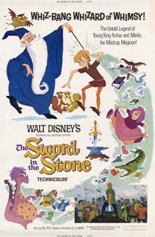
After a jazzy romp through modern London, Walt Disney jettisons us back in time for a medieval fantasy. Tales of King Arthur and his Knights of the Round Table are ripe for film adaptations. The House of Mouse takes a kid-friendly approach by adapting the first installment of T.H. White’s series The Once and Future King. By doing so, Disney finds plenty of ways to dazzle the eyes but they come up short in the quest to dazzle the mind.
When King Uther Pendragon passes away a sword appears in a London courtyard. It pierces both an anvil and the stone beneath it. An inscription on the sword declares "Who so Pulleth Out This Sword of this Stone and Anvil, is Rightwise King Born of England." Centuries pass and the stone is forgotten about by most. Forgotten, that is, until a young squire pulls the sword out without realizing what it is.
Did I just give the ending away? If you know nothing about King Arthur, then I apologize. For the 98% of you who already know this tale, you should know that this film has almost nothing to do with the titular sword. It merely bookends the tale of young Wart (Arthur), a peasant boy adopted as a student by the roaming wizard Merlin. Wart balances Merlin’s creative lessons with being a squire for his foster brother Kay, a wannabe knight.
Maybe it’s because I never read the book it’s based on. Maybe it’s because I’m not an aficionado of British fantasy literature. Maybe it’s because I’m an American. Whatever the reason, The Sword in the Stone just doesn’t do it for me. There are a number of cinematic weaknesses present but it’s all the style missteps that hurt it the most.
The Xerox animation technique that Disney started with One Hundred and One Dalmatians still looks rough. It helps the Middle Ages setting look appropriately grim and gritty but the sketch lines inside the animated characters are still distracting. The outlines of the characters flow well but the lack of consistency and continuity inside those lines makes the final product look a bit sloppy. That is not a word that should be used to describe a Disney product.
While One Hundred and One Dalmatians contained very few songs, this film tries to inject a little musical whimsy in its reels. The end result leaves a lot to be desired. None of the tunes are memorable and the most noteworthy song "Higitus Figitus" feels like a poor imitation of "Bibbidi-Bobbidi-Boo." This is an even larger detriment than it initially appears, given that this movie is geared more towards kids. If the kids don’t come away humming the tunes, you’ve missed the mark.
Very few Disney films up to this point have focused so sharply on children. Peter Pan was the last production to do so but that was released a decade before The Sword in the Stone. Disney films have always played well with younger audiences but they have always worked for adults as well. This film marks the first sharp divide between content directed at children and content directed at adults. Merlin drops references to a number of people, places and ideas that will go over younger kids’ heads.
On the flipside, parents might not be as mesmerized with the colorful animation, especially not if they’ve seen plenty of Disney films before this one. That’s not to say that the animation is inferior. The Xerox technique is still heavily flawed but the animators pull off a few neat tricks throughout. Merlin’s lessons all involve turning himself and Wart into animals. When they transform, they still retain some kind of identifiable characteristic to provide a reference point. This is also the case when Merlin engages in battle with Madam Mim. All of their transformations flow seamlessly.
Despite its highly regarded source material, the story feels incomplete. From the beginning it’s obvious that Wart will be the one to pull the sword from the stone. There is no central conflict driving the story from Point A to Point B though. Merlin’s lessons are little more than fanciful vignettes to provide Wart with wisdom before he realizes why he needs it. These lessons have nothing to do with Wart’s reason for pulling the sword from the stone, so these sequences could, cynically, be viewed as candy-coated time killers.
The only magic in The Sword in the Stone lies within what Merlin conjures up on the screen. For whatever reason, none of the pieces typically found in the Disney ‘formula’ click this time around. While it still showcases plenty of skill by the animators, this is one of the few truly passable Disney films. It might keep the kids occupied for an hour twenty but if you have any favorite Disney films, my advice is to stick with them.
For the first time since the 40s package films, a Disney movie does not begin with the opening of an old book. This is just the first of many differences in a new era for the studio. Whether they were aiming for a complete overhaul of everything Disney or not, there is something about this film that feels completely foreign, and I’m not talking about the London setting. Fewer songs, a new animation style, a simplified artistic vision, and a modern setting may shock fans of Disney’s two golden eras but the end result maintains the Disney standard of excellence.
Pongo, a Dalmatian, lives with his human, Roger, in London. After Pongo finds a wife for both himself and Roger (Perdita and Anita, respectively) he becomes the proud father of 15 puppies. He and his wife are thrilled at their blessings but their joy quickly turns to concern. Cruella De Vil, one of Anita’s former schoolmates, is mysteriously obsessed with acquiring the puppies at any cost.
After Roger refuses to sell the puppies to Cruella, she has a few of her lackeys break into the home and steal them. Desperate to reclaim their children, Pongo and Perdita use a country-wide network of dogs and other friendly animals to put out an alert. Thus begins a harrowing rescue attempt fraught with danger, not only from the winter-ravaged English countryside, but with Cruella De Vil hot on their tails in pursuit.
After all the lush and detailed art direction throughout the 50s, the animation of One Hundred and One Dalmatians is more than a little jarring. While they don’t abandon the multiplane camera, very little depth is put into the scenery. Disney’s emphasis on foreground characters grew during the preceding decade but this film takes a huge leap to keep the audience solely focused on the foreground.
Background elements like furniture and other décor are merely blobs of color with simple lines sketched over them to give the appearance of shape. Instead of a visually round environment, the only trace of three-dimensionality is with the characters and any objects they directly interact with. I spent much of the film in mental rebellion against this cost-saving venture.
The other major change is with the animation of the characters themselves. Beginning with this film, Disney became fully invested in the new Xerox photographing technology to cut costs. Prior to this move, Disney’s animators would sketch out characters on paper. These sketches would be given to re-drawers, who painted precise lines on animation cells. The Xerox method allowed the studio to eliminate the middle man and copy the sketches directly to the cells.
The end result quite literally resembles a moving sketchpad. By skipping the re-drawing phase, many of the animators’ reference and structural lines make it through to the final product. If it were an intentional move, it might be worth some merit but this effect is merely a by-product of an imperfect but cost-saving technology. The combination of this process and the art direction give One Hundred and One Dalmatians an unpolished look never before present in a Disney film.
This gritty/dirty quality is distracting at first but it actually works given the film’s modern setting. It helps make the city of London look appropriately blemished, while giving an edge to the countryside sequences. Fairy tales and fantasy adventures call for very crisp and clean environments but that same approach wouldn’t work for a story set in the real world. Even Lady and the Tramp had a bit of an edge to its street scenes. That doesn’t make this double whammy completely amenable, just tolerable.
One Hundred and One Dalmatians is still a fine Disney story. It promotes family values, persistence and kindness. Cruella De Vil is a little over the top and her motivation for snatching the puppies is kept a secret for too long. Knowing that motivation in advance really makes the timing of the reveal seem wrong. Leaking it a little earlier would help raise the dramatic tension during Pongo and Perdita’s search and rescue attempt.
The high point of the film has got to be the jazzy score. The opening itself is invigorating but a kind of free-wheeling attitude pervades much of the incidental music. This makes the film feel more contemporary than the actual setting of the film, I think. This might be one of the only of this film’s artistic decisions I can really get behind but the Disney team gets good marks for picking the perfect story to make these big transitions with.
After four solid or better films, Walt Disney and his master craftsmen go out of the 50s with a bang. The combination of a classic fairy tale, gorgeous animation and a tremendous classical score, is it any wonder that Sleeping Beauty is perched high among the best of the studio’s work? Not only is this film one of my personal favorites from the Disney Vault, but it has all the credibility to back up the millions of fans who adore this picture.
A kingdom rejoices at the birth of a daughter for their King Stefan and Queen Leah. Everybody turns out to bestow a blessing upon the dear child- a neighboring king, dignitaries and magical fairies. The joy comes to an abrupt halt when an evil sorceress named Maleficent crashes the party. She places a curse upon the child, dooming her to die on her sixteenth birthday. After Maleficent disappears in supposed triumph, a good fairy does her best to counter the witch’s curse. In an extra effort to protect the child, three fairies take the girl away to raise her in the woods until her ill-fated birthday has passed.
On Princess Aurora’s sixteenth birthday, the fairies’ plan begins to unravel. The truth of her royal standing is hard for the beautiful girl to take, especially after falling in love with a handsome man in the forest earlier that day. To make matters worse, Maleficent has discovered the fairies’ hiding place and swoops in on them to execute her murderous plans. It’s up to the fairies and the handsome man from the forest (a prince, no less!) to save Aurora and restore happiness to the kingdom.
Can Disney do fairy tales or what? These classic tales of beautiful damsels in distress under the oppressive hand of witches and evil step-mothers allow Disney to pull out all the animation stops to create worlds as vivid and beautiful as the ones that exist within our minds. This time around, the Disney team takes an unexpected turn with their work. Many of the backgrounds replicate the look and feel of Middle Ages artworks. Trees and flags are tall and slender, there is a strong emphasis on vertical lines, and the detail is rich and all of it remains in focus.
The richness of many of the backgrounds makes it hard for the foreground to compete, leading the characters to have a flatter look than in previous films. This has been an ongoing trend for Disney productions throughout the 50s. The drive to cut costs hasn’t sacrificed too much quality yet though.
Disney’s obsession with this project comes out best with the music. Instead of risking comparisons to Cinderella by flooding the film with catchy tunes, Sleeping Beauty is built around a pre-existing score. Piotr Tchaikovsky’s gorgeous ballet composition sets the pace and tone of the film. I don’t if know the music used in this film was used at similar moments in the ballet but it matches the action and mood perfectly.
It is clear to see where Disney takes creative liberties with story elements and character personalities. Purists may complain but half the fun of watching the Disney version of a classic fairy tale is to see what little twists are put in. Sleeping Beauty makes bold steps forward while also remembering the classic films that came before it. Just like Snow White and Cinderella, Princess Aurora is friends with all the animals she meets. There is also a clever reference to Fantasia when the fairies are cleaning their cottage.
While the flat animation may not bother most (heck, many won’t even really notice it), it does hold Sleeping Beauty back a hair for me. With the art direction and the music, this film could have topped Cinderella. Instead, they are merely equals for vastly different reasons. Solid story plus Disney’s ingenuity equals a spectacular treat every time. This film marks the end of an era for Disney. Their second classical era closes out with a triumph that makes you yearn for the ‘good old days’ with every film released since.
 I grew up watching Winnie the Pooh cartoons every Saturday morning as a kid. I remember loving the characters and adventures they embarked on. Watching this original animated collaboration was quite an interesting experience to say the least. Of all the Disney animated films I have watched on this journey from Snow White to present day, The Many Adventures of Winnie the Pooh elicited the most jarring reaction in me from an adult’s perspective yet.