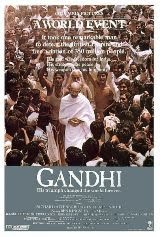
This is going to be a very short review for a very long film. While recent biopics have focused on the most interesting parts of their subjects’ lives, Gandhi is devoted to painting a broad picture of the life and work of Mohandas Karamchand Gandhi. While there is no lack of drama and power, director Richard Attenborough’s approach results in a slow pace that will be a turn-off for many viewers. But if you are determined enough to tackle this lengthy, weighty film, you will find yourself awestruck.
The film opens with Gandhi’s assassination and funeral. We then flash back to 1893, where Gandhi experiences segregation and injustice for being ‘colored’ while working as a lawyer in South Africa. This motivates the young man to lead a non-violent movement for the rights of Indian people in the country. After several brutal incidents with the authorities, Gandhi’s movement gains international attention and his people are awarded their rights.
Several years later, Gandhi returns to his homeland, where he is welcomed as a national hero. He is successfully recruited into being one of the leaders for India’s struggle for independence from the British Empire. Much of the film covers this, the bulk of his life’s work, as he uses civil disobedience to highlight Britain’s oppression of the Indian people. Many of Gandhi’s struggles, triumphs and disappointments play out as India moves towards independence and faces conflict after attaining that goal.
Gandhi is an epic film. The scope, the locations, the subject matter- everything about this film is epic. It may not feature any dazzling camerawork or mind-blowing special effects but you will have a hard time topping the human drama on display here. Independence, freedom, justice and dignity are all goals and themes that resonate with us all. Seeing one man lead such a large-scale struggle for all of these things is astounding. Add to this the fact that everything in this film is based on real events and you cannot help but be overwhelmed by the audacity and fortitude of Gandhi.
Ben Kingsley’s performance is crucial to this film’s success. Many biopics falter in casting and hire actors and actresses who bear little to no resemblance to the real person being featured. Kingsley, hands down, looks just like Gandhi in this film. It certainly helps that Kingsley’s ancestry hails from the same region of India as Gandhi but it’s more than just that. Kingsley goes all out for the part, losing a dramatic amount of weight and perfectly affecting Gandhi’s voice and mannerisms. Beyond Kingsley, not much really matters in this film regarding the cast. It’s a film called Gandhi and they got Gandhi so right it’s chilling.
Richard Attenborough has stated that he never meant to become a director; he just wanted to direct this film. Considering it took Attenborough nearly 20 years to make his dream project a reality, the attention to detail in this film makes all the more sense. Sure, this results in a three-hour-plus historical drama that may bore those in the current ADHD Generation to tears at times, but cinephiles, history buffs and anyone who cares about humanity in general will consider Gandhi a triumph. It truly is an experience that words fall short of describing, so I won’t even try elaborating further.
Filled with paranoia, suspicion and fear, Ron Howard’s Oscar-winning film is a challenging watch. The audience is set behind the veil of the main character’s mental illness, leading viewers on a parallel search for truth. This makes for very delicate filmmaking, made even more so due to the film being based on a true story, but Howard and company are up to the task.
John Nash (Russell Crowe) begins his graduate studies at Princeton and meets a colorful array of people. His roommate is wild, his friends are entertaining and women intimidate him to no end. Nash sets out to come up with a truly original idea for his thesis, leading to his groundbreaking work in mathematical economics. After making waves with his work, Nash takes a teaching position at MIT, where he falls in love with one of his students (Jennifer Connelly). Nash is also recruited to a top-secret CIA project, where he is assigned to look for Soviet codes being printed in major media publications.
Nash grows paranoid that he is being watched and followed by the Soviets, concerning his wife. His world is shattered when he is diagnosed with paranoid schizophrenia and must work to figure out what in his life (past and present) is really real. Nash is given medication that puts a strain on his married life but when he stops taking the medication in a stubborn attempt to fight his illness on his own, he only makes matter worse. The film goes on to detail Nash’s struggle throughout his brilliant but troubled life.
I must confess that I knew the film’s twist reveal before I ever saw it. That being said, major kudos go out to both screenwriter Akiva Goldsman and director Ron Howard for the execution of the film after the twist reveal about halfway through. Despite knowing what Nash is imagining, there were times where I second-guessed what I thought was real and what was illusion. I don’t know that I’ve ever had that happen to me coming into a film that was ‘spoiled’ for me.
Russell Crowe is solid as John Nash and really nails the paranoia and mannerisms of someone suffering from this kind of mental illness. Jennifer Connelly definitely deserved the Oscar she won for her role as Nash’s wife Alicia. Her performance is as emotionally draining to watch as I’m sure it was to portray during filming. You feel bad for Nash and his struggles but you feel even worse for Alicia as her husband’s illness tears both her life and their marriage apart.
Ed Harris is perfect as CIA operative William Parcher. His cold, forceful and unforgiving manner creates a powerful antagonist. Paul Bettany is both hilarious and slightly creepy as Nash’s off-kilter roommate Charles Herman. Between these four characters, A Beautiful Mind has a foundation of rock-solid acting for the roles that matter most. The rest of the supporting cast performs adequately and everyone gets the job done (no small feat for a Hollywood film anymore).
One hang-up that could hurt audience appreciation is the pace of the second half of the film. The first half features Nash developing his whiz-bang theory and climaxes with his diagnosis. The second half drags on at times through Nash’s attempt to cope with his illness. The action rises and falls but the pace really lags, making the film feel much longer than its two-hour and 15 minute run time suggests.
Between the pacing and perhaps also being spoiled before seeing the film, A Beautiful Mind misses out on my lowest ‘great’ rating for a film. That doesn’t mean it’s not worth seeing though. If you like biopics and human drama, you’re bound to like this film. I’ll have to see the other nominees from 2001 before I can comment on its merits as a Best Picture winner.
Looking back at all the films that have dominated the Oscars recently (and throughout the Acadmey’s history for that matter), it’s almost unfathomable that a screwball romantic comedy was the first (and still one of only three films) to capture ‘The Big Five’ (Best Picture, Director, Actor, Actress and Screenplay). After watching It Happened One Night, however, one thing is absolutely clear- if you don’t like this film, then you cannot call yourself a movie lover.
Ellie Andrews (Claudette Colbert), a spoiled young heiress, marries against her father’s will. Daddy breaks in on the new couple and before they consummate their nuptials and holds her in isolation on a private yacht until she comes to her senses. Furious and crafty, Ellie manages to swim to shore and attempts to make her way to New York City to be with her beau. Her attempts to remain unnoticed fail, as newspaper reporter Peter Warne (Clark Gable) realizes who she is and what she’s up to.
After missing their bus one morning, Peter makes a proposition- he won’t alert her father to her whereabouts if she promises him an exclusive story on her flight from her father. She attempts to bribe him but Peter bluntly advises that he doesn’t care about her or her father’s money. This starts a tension-filled journey across the country that’s full of snide comments, snappy one-liners and plenty of screwball antics as Ellie and Peter’s animosity towards each other gradually melts into attraction.
One of the things I’ve learned from watching films from Hollywood’s early days is that it can be very difficult to appreciate the originators of what have become genre conventions. Being a child of the late 80s and early 90s, nearly all of the films I grew up watching laid their foundations on the films that came before them. Modern audiences often take for granted or don’t even realize that they have the privilege of benefiting from over 80 years of film production advancements. It’s a daunting task to look for the originality in something that seems so predictable by today’s standards.
Having finally seen It Happened One Night, I can instantly call to mind dozens of references and allusions to this classic in any number of other films and TV shows- heck even Looney Tunes cartoons! It’s not enough to recognize the merits of older films like this- to truly appreciate it you must also recognize the legacy and impact it has had on popular culture. This is one of those films that are rife with scenes, lines and gags worth recycling and paying homage to.
Everything in director Frank Capra’s film seems to be firing on all cylinders. The chemistry between Gable and Colbert is palpable and they seem to deliver their lines effortlessly. You’d think they had been working together for years but this was their first picture together. On top of this, Colbert was very disappointed in the script and evidently complained every day of production. This goes to show just how fantastic she and Gable are at their craft, able to bury any inhibitions while the cameras are rolling.
Robert Riskin’s screenplay is breezy and full of playful lines. Even before the puritanical Motion Picture Producers Code was established, Riskin’s script makes clever use of double-entendres to skirt around the decency standards of the day. This kept the film tasteful but bawdy enough to appeal to a wide audience. Somehow, despite encountering these gags and lines any number of times through modern movies, there is freshness in their delivery here.
I was initially only going to give this film 3.75 stars out of 5 because there were elements that, due to my generation, come off as predictable. Having seen a number of references and allusions to It Happened One Night recently though, I can’t possibly deny it the greatness it deserves. I fear that my rating may still be limited by seeing these things a thousand times before but any time I see someone flash a little leg to catch a cab, put a sheet to separate his-and-hers beds, or make a reference to the Walls of Jericho, you better believe this movie will come to mind.
Don’t watch this film simply because it is the stuff of Oscar legend. Watch it because it is a charming and endearing film that paved the way for the romantic comedy genre. Paying your respects to the past never felt so good.
Every year, plenty of movies are made about relationships. These include chick flicks with no grasp on reality, hard-hitting Oscar-bait dramas and indie-flicks that nobody sees. Every now and again, someone manages to make a comedy containing poignant commentary on modern relationships. Incredibly vulgar but oddly endearing, I Love You, Man strives to be one of these rarities.
Real estate agent Peter Klaven (Paul Rudd) is newly engaged to the beautiful Zooey (Rashida Jones). There’s just one problem- Peter doesn’t have any strong male friends and no one in mind to be his best man for the wedding. Peter struggles through a few awkward ‘man dates’ but strikes gold when a quirky investor named Sydney (Jason Segel) shows up at one of his open houses. Sydney’s ‘tell it like it is’ attitude is both amusing and enlightening and Peter begins regularly hanging out with him.
Zooey is happy for Peter until he starts spending a little too much time with Sydney in his ‘man cave.’ After Sydney’s veiled attempt to convince Zooey that she need to perform fellatio on her man during an engagement party speech, Zooey’s opinion of the man sours. Several incidents later, Peter cuts ties with Sydney, fearing that their friendship is hurting his relationship with Zooey. Naturally, everyone comes to their senses and we get an amusingly awkward but happy ending.
Despite a seeming paint-by-numbers plot, I Love You, Man is different. In some ways, it’s a chick flick for guys (or maybe just a chick flick with guys in the lead instead of girls) with loads of foul language and boyish humor. It can’t quite break away from its formulaic feel but it is a very unique role reversal. Crassness aside, it does offer a candid look at male friendship. Men are stereotyped to have all kinds of ‘guy friends’ that they go do ‘guy stuff’ with. It’s nice to see a film debunk that myth.
While the script makes a few genuinely interesting remarks about male friendship and relationships in general, none of the commentary is very memorable. This means that I Love You, Man is not the second coming of When Harry Met Sally. Some fans of emotionally honest comedies may be disappointed by this but I doubt it was the filmmakers plan in the first place. It seems like this film was designed as a blend of When Harry Met Sally and The 40 Year Old Virgin.
Does this mean that the meat of the film is dumbed down with potty humor to attract male viewers? Perhaps. Then again, the non-raunchy components wouldn’t have made for a very satisfying film on their own and would have seemed like an uninspired attempt to modernize When Harry Met Sally. By taking the path that it did, the filmmakers succeeded in making a film worth seeing once and that can’t be a bad thing.
Perhaps the film is held back by its cast. There are no leading actors or actresses in this production. It’s tough to sell a movie composed of people best suited or at least most known for their supporting role work. Paul Rudd works as an average guy and Jason Segel works as Sydney but they fail to make their characters dynamic in any way. Sure, they hit their marks and drop their lines when they need to but there’s some misfiring when it comes to their comedic chemistry.
I Love You, Man is good for a few innocent and several not-so-innocent laughs. You will be able to remember the basic gist of the film but few if any scenes, lines or characters will stick with you for very long. You can see better but you can definitely see a lot worse than this.
Mel Brooks’ career features a number of standout hits but, as with any director, he is capable of missing the mark. Some of his films remain as classics, some have been forgotten about and other remain somewhere in between. History of the World Part I falls into that awkward middle ground. While Brooks has been successful in spoofing westerns and monster movies, this bold attempt to skewer several Hollywood genres and history at the same time falls short along the way.
The film is broken into five main components. ‘The Dawn of Man’ focuses on the evolution of cavemen as they move towards becoming a more sophisticated species. Brooks covers the creation of fire, marriage, art, music and comedy. We then move on to a brief synopsis of ‘The Old Testament,’ where Brooks appears as Moses irreverently proclaiming God’s commandments unto the Hebrew people.
Jumping forward a few centuries, Brooks lays into ‘The Roman Empire,’ where he plays a stand-up philosopher named Comicus. He falls in love with one of Caesar’s virgins (Mary-Margaret Humes) and befriends an Ethiopian slave (Gregory Hines). Caesar (Dom DeLuise) is not impressed by Comicus’ act. The philosopher and his new pals flea the wrath of Caesar, bumping into Jesus Christ along the way.
We then move ahead to a goofy, Broadway-esque song and dance number for ‘The Spanish Inquisition.’ We then segue into ‘The French Revolution,’ where Cloris Leachman, as Madame Defarge, leads an uprising against the aristocracy. Catching wind to the tide of change, shifty King Louis of France (Brooks again) looks for a way to avoid the guillotine.
For the most part, History of the World Part I is enjoyable. Between Orson Welles’ absurdly serious narration and some amusing references to great films of yesteryear, there’s enough going on between the lines so to speak to keep a film buff chuckling. For those who have never seen 2001: A Space Odyssey (spoofed during ‘The Dawn of Man’) or any of the ‘sword-and-sandal’ flicks Brooks takes aim at, some of the humor is lost.
Part of the problem is probably because we are so far removed from the Bible epics of the 1950s. Everyone knows about the clichés and conventions of monster movies and westerns, which is why Young Frankenstein and Blazing Saddles worked so well for Brooks. But by 1981, films like Ben-Hur and The Ten Commandments, while still appreciated, were considered relics of the past by many moviegoers. Had this film come out in the 70s, the satire might have seemed fresher and more people could have gotten the jokes.
Perhaps the scope is also part of the problem. History of the World Part I, while sounding like it limits itself, takes on a bit too much and ends up delivering too little. The Roman and French pieces make up a bulk of the film but even they seem to drag on a tad too long by the end of it all. It’s a shame that a 92-minute film could be described as feeling long. To be fair though, had this film been little more than vignettes lampooning historical moments, it would have seemed like a half-baked Monty Python clone. I guess Mel Brooks was bound to lose either way.
If you’re a fan of Brooks’ other work, this film is worth seeing. The laughs are more gimmick-oriented but Mel hasn’t lost his touch yet. For the rest of you out there, if you happen upon this film on TV, feel free to check it out. Clever it may be but there’s no need to rush out for a copy.
Without a doubt, 1974 was Mel Brooks’ finest year as a filmmaker. In February he released Blazing Saddles, the hilarious and politically incorrect spoof of the Western genre. An on-set conversation with actor Gene Wilder led to this satire of Hollywood’s most famous movie-monster. While not quite as funny as Blazing Saddles, Young Frankenstein is in league with its predecessor as one of the greatest comedies of all time.
Dr. Frederick Frankenstein (Gene Wilder) has spent his whole life becoming a respectable doctor and lecturer in America. He wants nothing to do with his family legacy (you know, the whole monster creation thing) and even alters the way his last name is pronounced (fronk-en-steen, he insists). This all changes when he is notified that he has inherited his late grandfather’s estate in Transylvania.
After meeting a gorgeous lab assistant, Inga, and estate servants Igor and Frau Blücher, Frederick grows to embrace his roots and sets off to create a creature of his own. Naturally, things go awry and Frederick struggles to control his mammoth creation and assure the local townsfolk that his creature poses no threat to them.
Shot appropriately in black-and-white and featuring a delightful period score, Young Frankenstein finds just about every way imaginable to poke fun at the previous film incarnations of Frankenstein while avoiding being mean-spirited. Mel Brooks clearly understands what a landmark film Frankenstein was, even though it became the source of many science-fiction and mad scientist conventions and clichés. To do satire correctly, you have to respect the source material. Brooks’ reverential tongue-in-cheek attitude keeps things light and makes it clear that everyone was having a blast while making this film.
The original Frankenstein is a classic- no doubt about it. The numerous sequels (and time for that matter) were not kind to the legacy of the story, turning the hulking monster into more of a joke than anything else. Brooks channels into the creakiness of the Frankenstein legacy and works every angle of comedy to get the best results. For a film that was made for the sake of having fun, the richness of comedic details is astounding.
The actors hold nothing back in their performances. They play their stereotypical characters with a zest and fervor that can’t possibly be misconstrued as overacting. Gene Wilder’s manic performance as Frederick Frankenstein is among the best in his career. His facial expressions, especially the eyes, and body movements are so meticulous yet perfect. There aren’t enough actors capable of selling this kind of performance anymore.
The supporting cast is also spot-on. The ditzy lab assistant, the creepy servant Igor (whose hump amusingly switches places periodically throughout the film) and the cold and sinister Frau Blücher- they all drop their one-liners without hesitation and do it with the utmost sincerity. This knack for wit, some of which was ad-libbed on set to make scenes funnier, seems to have been lost over time. Modern genre spoofs feature stale writing with obvious one-liners and sight gags. Where recent comedies feature forced dialogue to cover up lousy acting, Young Frankenstein captures the best of both.
The humor does not stop with the cast though. The set design opens itself up to snarky remarks and even adds to the humor when characters wander the castle. The sound effects and even the music get in on the laughs. Lightning crashes and horses scream whenever someone mentions Frau Blücher by name, the film score rises and falls to clue you in on what’s coming next. All of this shows that every member of the team was working as hard as possible to achieve their goal.
Admittedly, I fear that the films of my generation may stand in the way of me fully appreciating Young Frankenstein for the comedy gold that it is. Comedy has gradually gotten stupider over the years and the art of the spoof is all but lost. Given films like the Scary Movie franchise and its followers, modern audiences have all but lost their appetite for satire and spoofs. It’s easier for us to see jokes coming now, which, despite protecting us from stupid comedy like Disaster Movie, makes it harder to let go of our inhibitions and let the filmmakers have their way with us.
If you have seen Frankenstein or at least know the basic premise, you need to see Young Frankenstein. Even if you don’t like monster movies (or perhaps especially if you don’t like them) you will get a kick out of Mel Brooks and his friends firing on all cylinders.
This is the second film and first ‘talkie’ to win Best Picture at the Oscars. Though skepticism and scandal surrounds its Oscar win, no one can deny that The Broadway Melody is a charming film that’s a feast for the eyes and ears.
Harriet “Hank” Mahoney and her sister Queenie are a vaudeville act in the Mid-West. Hank’s boyfriend Eddie writes a snappy number that gets the attention of a big-wig Broadway producer. Eddie convinces the girls to head to New York, assuring them that he’ll find a way to get them into the production. Hank and Queenie discover what it’s like to audition for the big time and what it takes to keep your spot once you’ve got it.
Eddie slowly grows cold for Hank and sweet for Queenie but the younger sister refuses to break her sister’s heart and begins dating a New York playboy. It doesn’t hurt that the show is a hit and Queenie is a rising star either. Rather than giving into the vices of the big city, Hank fights against them in an effort to keep Queenie and Eddie from making mistakes they’ll all regret.
Film snobs like to thumb their noses at this film. They believe the reasons it won Best Picture are because the 1929 crop of nominees were nothing but weak films as a result from studios scrambling to embrace the incorporation of sound and because the film’s producer Louis B. Mayer (the third ‘M’ in MGM) was the vote supervisor for the Oscars.
To be fair, this is the first film from 1929 that I’ve ever seen, so I have no true basis for comparison. And it’s true that The Broadway Melody pales in comparison to the scope of the inaugural winner Wings, but that doesn’t change the fact that this honestly looks like an Oscar-winning movie. Where Wings was an example of what location shooting and technical daring can do, The Broadway Melody triumphs in showcasing the virtues of the studio system.
Lavish costumes, dazzling sets and oozing with charm, this film really makes the most of its budget. The musical numbers are very clearly overdubbed but there’s no harm in that (what movie-musical doesn’t feature overdubbing anymore?). The concept of the ‘backstage’ musical and movie were probably nothing new with this film but it’s the first to do so in full sound. If you take the proper context into consideration, The Broadway Melody elevates this now-clichéd concept to new heights with the sound, music and very detailed sets.
The story, though tame by today’s standards, is appreciable. Hank is willing to make sacrifices to ensure her sister’s happiness and Queenie shows that even a star-eyed newcomer to the big city can maintain some semblance of morality. You can say all you want about ‘old-fashioned morals,’ but common sense never goes out of style.
The Broadway Melody may be almost pure confection but it sure tastes sweet. It may not rank among the best films to win Best Picture but, for what it was at the time, the honor makes complete sense. It’s not a crying shame that this film has largely been forgotten about (though fans of Singin’ in the Rain will find this is the source for several of that film’s numbers) but if you should have the opportunity to watch this little gem, please do so.
Who doesn’t love taking a few shots at Hollywood every now and then? The film industry is full of frauds, egomaniacs and naïve fools. Comedic legend Steve Martin manages to wrap all of these industry archetypes into an amusing tale about a bunch of wannabes desperate fulfill their misguided dreams of breaking into the big time.
Bobby Bowfinger (Steve Martin) is trying to launch a career as a film producer. He’s been working at achieving his dream for years but has only managed to save a paltry $2,184 to pay for production. A studio executive gets Bowfinger’s hopes up by saying that he’ll distribute the film if Bowfinger can get Hollywood mega-star Kit Ramsey as the lead. When Ramsey refuses to work on such a low-budget production, Bowfinger is crushed but he doesn’t give up.
Taking the half-baked script, written by an accountant, and a team of overzealous and under-skilled actors, Bowfinger plots to make the film guerilla style- his actors and camera crew will ambush Kit Ramsey in and around Hollywood to get the shots they need while also having him as the unknowing star of their production. Bowfinger has the rest of the cast thinking that Ramsey knows what is going on and is merely ‘method acting’ to portray his confusion. Unfortunately, Ramsey is a seriously paranoid member of the MindHead cult- a connection that seriously jeopardizes the production.
As amusing as Bowfinger is, there is a problem. Viewers who aren’t keen on the intricacies of Hollywood will miss about half of the comedy in this film. That’s not a huge problem but what most people will see is just the zany antics of a bunch of pathetic wannabes. Just under the surface of what appears to be a screwball comedy lays a foundation of satire, black comedy and a slew of Martin’s own observations after years in the business.
It’s a shame that most people will miss out on some of the details. I’m willing to bet that (aside from the guerilla filmmaking) there is an awful lot of truth about Hollywood in this film. Bowfinger tackles a number of ideas: cult of celebrity status, ageism in Hollywood, tired cliché-ridden genre films, the manipulation of young actors, financing and more. The lampooning of celebrity cult-like groups such as Scientology are the most obvious targets but Martin is a sly writer and knows how to avoid the one-trick pony trap.
This film may just mark the last legitimately funny live-action role Eddie Murphy has played (which is sad considering it’s been 11 years since Bowfinger was released) but he rightfully steals the show. First, his manic paranoia as Kit Ramsey is delightful. His other performance as Kit’s awkward brother Jiff, who the crew uses to film some close-ups, is amusing because it’s the first time we get to see Murphy play a nerdy character without the aid of a fat suit. These two polar opposites are fun to watch.
At times it’s hard to cheer for Bowfinger and his band of misfits because they resort to stalker behavior and Bowfinger himself gives in to some of the evils of Hollywood that have frustrated him in the past. Thank goodness no one has attempted to make a real movie by the same tactics on display here. In the end, just about everyone appreciates a good underdog story, which is what this is.
Funny but sadly forgettable, Bowfinger is one of those gems that are worth dusting off every now and again for a few hearty chuckles. Martin may fill his script with winks and nods to those in the know but there’s a little something for everyone here.
After taking a step forward with Fun and Fancy Free, Walt Disney and his animation team takes a slight step backward by returning to the overstuffed ‘package’ film format. Melody Time has its share of virtues but it can’t escape the stigma of seeming like another Fantasia clone that fails to live up to the achievements of the original.
The film opens reasonably strong with ‘Once Upon a Wintertime,’ a tale of two young people in love on a romp through the winter scenery. The inventive but forgettable ‘Bumble Boogie’ comes next and features a jazz variation of “Flight of the Bumblebee.” Up next is the classic short 'The Legend of Johnny Appleseed.' Most people my age and younger have seen this charming animated tale while growing up and it still has all the charm and magic as the first time you may have seen it.
'Appleseed' is a tough act to follow but 'Little Toot' does well enough in the cleanup spot. It’s about a rambunctious little tugboat and features the signing of the Andrews Sisters. 'Trees' offers a bland recitation of a poem by Alfred Joyce Kilmer. Saving the day is 'Blame it on the Samba,' a wonderfully entertaining short featuring Donald Duck, José Carioca and the crazy Aracuan bird. This reunion from The Three Caballeros is a welcome attraction for me, even though I’ve grown tired of the formulaic structure of these War-era Disney films.
Wrapping up Melody Time is 'Pecos Bill,' a tall tale of the legendary Western characters adventures spun by none other than Roy Rogers. The home video release is cleaned up for political correctness (gone are virtually all depictions of our hero smoking) but the good-natured fun remains. It ends the film on a high note, which is good because anything less than a solid ending would have left audiences frustrated with this re-serving of more of the same.
I don’t mean for this review to come off so negative. The animation is solid, the music is enjoyable and the stories are fine. My beef is that ‘fine’ isn’t good enough for a Disney product. I understand that World War II drained Disney of resources and box office returns tanked but this is the fifth consecutive Disney film to lack a central story line. There is no meat and no growth for characters. All we get are a few splashy colors, fanciful music and short stories. This cheap and easy approach has lost its luster and leaves you longing for the glory days of Snow White, Pinocchio and Bambi.
While Melody Time never tries to be the second coming of Fantasia, it’s impossible not to compare them based on their similar structures. Where Fantasia was a bold and innovative experiment, Melody Time is intentionally formulaic and manufactured. The end product is still worth watching though; it’s just not a main course that you’ll be asking for seconds of.
After three consecutive ‘package’ films featuring multiple shorts, Walt Disney pulls his animators together for a more concentrated production. Instead of half a dozen or more shorts, we are given just two stories. While still technically a short, each component is much longer that what the recent Disney collections offered. While this is a welcome breath of fresh air, Fun and Fancy Free is also not quite the one-two punch Disney may have been gunning for.
Fun and Fancy Free opens with a song by Jiminy Cricket, who wanders into the living room of a house. There he finds two sad looking toys and decides to cheer them up with a story. While looking for a book to read, he discovers a story on record titled ‘Bongo.’ Narrated by Dinah Shore, ‘Bongo’ is the story of a circus bear who finds himself lost in the wild. After meeting some of the local bears, Bongo falls in love with a young female, drawing the ire of one of her hopeful suitors. Both bears vie for her attention and affection.
After finishing the tale of Bongo, Jiminy heads over to a little girl’s birthday party. This segment is live-action footage, where ventriloquist Edgar Bergen and his dummies Charlie Parker and Mortimer Snerd are the entertainment. Bergen springs into the story of Jack and the Beanstalk, only the audience is treated to the animated tale of ‘Mickey and the Beanstalk.’ Mickey, Donald and Goofy take on Willie the Giant in order to restore peace and prosperity to their valley.
As entertaining as the last few ensemble films had been for Disney, the formula was getting stale. Films like Make Mine Music and The Three Caballeros contained segments that were hit-or-miss in nature. This, in conjunction with the fact that they don’t focus on a popular story like Disney’s early works, is almost certainly why these so-called ‘package’ films aren’t remembered or loved as dearly as the full-length, one-story films.
Fun and Fancy Free takes a step in the right direction by tackling two longer short stories. This gives the audience more substance to latch onto. It’s also clear that it afforded Disney’s animators more time to focus on their work. Both ‘Bongo’ and ‘Mickey and the Beanstalk’ have more detailed animation, even though it doesn’t quite compare with Disney’s early films.
‘Bongo’ isn’t a very memorable tale but it is cute and something kids will enjoy. ‘Mickey and the Beanstalk’ is something of a Disney classic. It has been repackaged and the narration altered several different times. I recall watching this on a Mickey Mouse VHS collection as a child and loving it. It still has a magical charm that thrills the imagination. Seeing it with the original narration is interesting because Edgar Bergen and his dummy friends add commentary to the on-screen action that is often times amusing.
‘Mickey and the Beanstalk’ is the better of the two shorts in this film but ‘Bongo’ still gets the job done. Taken separately, the ratings would be quite differently. As a sum of its parts though, Fun and Fancy Free under-performs ever so slightly.
 This is going to be a very short review for a very long film. While recent biopics have focused on the most interesting parts of their subjects’ lives, Gandhi is devoted to painting a broad picture of the life and work of Mohandas Karamchand Gandhi. While there is no lack of drama and power, director Richard Attenborough’s approach results in a slow pace that will be a turn-off for many viewers. But if you are determined enough to tackle this lengthy, weighty film, you will find yourself awestruck.


