Wednesday, May 28, 2014

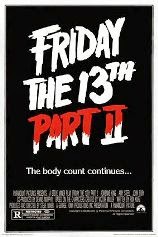
Friday the 13th Part 2 (1981)

Before there were Saw and Paranormal Activity movies coming out every year, there was the Friday the 13th franchise- cranking out abysmal films on the cheap that were guaranteed to rake in a sizable profit off the bloodlust of 1980s teenagers. This, the first of many sequels, is no different from any other paint-by-numbers slasher flick. It also sets the bar quite low for the installments that followed.

While only 87 minutes long, the first ten minutes of this film are a re-airing of the final ten minutes of the original Friday the 13th. Flashforward two months and the lone survivor of the Camp Crystal Lake murders discovers Mrs. Voorhees’s head in her refrigerator and then bites the dust at the hand of an unseen killer.

Now flashforward again five years into the future and a new batch of idealistic wannabe camp counselors are setting up shop on the banks of Crystal Lake, not too far from where previous horrors occurred. Fueled by curiosity over Mrs. Voorhees’s exploits and local legends that her son, Jason Voorhees, is actually still alive and avenging his mother’s death, some of the young adults start down a slippery slope of bad decisions that dooms everyone at their camp.

Everywhere you look in this film, there are signs that it was made for a quick payday. It may have had twice the budget as the original, but its qualitative return on investment is dismal. The acting is even worse this time around and the gore makeup barely comes off with a passing grade. Also, I must beat a dead horse and complain about the dearth of likeable characters. I am open to having a few immoral disposable teenagers in a film to be the first couple knocked off, but the core characters have to be developed and see growth during a film for audiences to get emotionally attached to them.

Interestingly enough, Jason Voorhees himself is Part 2’s biggest problem. It’s called retroactive continuity, or retcon for short. Audiences are led to believe one thing and then later events erase part or all of what was assumed to be historical fact. It happens a lot in soap operas and lousy sequels (I’m looking at you George Lucas).

In Part 2, Jason is the retcon. In the original Friday the 13th, Jason drowned in the 1950s due to inattentive counselors, which explains why his mother would go to such bloody lengths to keep the camp closed years later. Now we are to believe that he did not die. In fact, he’s been living in a shack in the woods and saw his mother get snuffed out in the first film. Jason appeared as a nightmare at the end of the first film- disfigured and scrawny. Well, now he’s the size of an NFL lineman and all muscle.

If I am to believe this scenario, I have to understand a few things. Why, if he did not drown in 1958, didn’t Jason seek out his mother immediately after surviving his near-death experience? How does he find food to eat in the back woods? Where does he acquire clothing from? Why didn’t he reveal himself to his mother in the first Friday the 13th when she showed up at Camp Crystal Lake? Part 2 never even approaches answering these questions, which are necessary to make the whole thing make even a lick of sense.

One interesting thing about Jason is that he doesn’t waste any time on killing people. Most other horror films let their protagonists linger in whatever immoral shenanigans they partake of before paying the price. Jason’s victims barely get into the act of anything before he clobbers them with whatever is handy. Unfortunately, Part 2 contains a closing scene similar to its predecessor, all but assuring us of another sequel.

RATING: 0.5 out of 5

Monday, May 26, 2014

SECOND HELPINGS: Friday the 13th (1980)

This is the first of what will be many Second Helpings reviews that I write over the years. I just want to explain to you all what to expect from these things from here on out before we lay into this silly horror film.

Essentially, there will be two types of Second Helping reviews. First, there will be reviews for films that I previously rated but did not write a first review for. Reviews for these types of films will be similar to a first-time review you are accustomed to seeing. They will also include a dash of informal content.

The second kind of Second Helping review will be for films that I already wrote a review for. These will be very informal and compare my initial review with how I felt about the film the latest time through. Consenting opinions will be brief and only elaborate so far. In those instances where I have changed my mind about a film, expect a more in-depth breakdown of the film that provides my justification for changing its rating.

Now for the film at hand…

Friday the 13th begins with the murder of two camp counselors in 1958. Flashforward to 1979, and a group of aspiring camp counselors have gathered to re-open Camp Crystal Lake. The locals are nervous because they remember the murders and feel the camp is cursed. All warnings aside, the young folk forge ahead with their plans. Unbeknownst to them (for a while at least) they are getting picked off one by one by an unseen killer who is determined to see Camp Crystal Lake remain closed.

There is a good reason why this film series gets picked on, spoofed, and referenced so much. The series as a whole is terrible but this franchise-opener actually has some promise buried in the reels. Horror films have almost always stuck to the formula of starting with a moderate sized cast and thinning the herd gradually down to a lucky (or unlucky) few. While that is certainly in play here, I like the reason for the killing, which is oftentimes not very convincing in slasher flicks. The killer has a unique and powerful motivation for keeping Camp Crystal Lake on ice. Everything surrounding this motivation, however, is deeply flawed.

Let’s start with the basics- Friday the 13th offers up little in the way of likeable characters. Instead of building up characters that we care about, we are expected to care simply because someone is trying to kill them all. Most of the would-be counselors in this film take any chance they can get to smoke dope or have sex. Maybe I’m just a prude, but when you do stupid things, expect consequences for your bad decisions. Since this is a horror film, bad decisions flow almost as freely as the blood.

Compounding our misery is the fact that the acting is, on the whole, very poor. Deliveries are unrealistic, poorly timed, and sometimes just don’t make much sense. The main female good guy (Adrienne King) does some good screaming and looks good and terrified when necessary. Aside from this, the only notable thing about the acting in this film is that Kevin Bacon is in it.

I will say that some of the special effects makeup work looks pretty good. Unfortunately the makeup artists’ work is squandered by surrounding realistic-looking wounds with ridiculous spurts, spatters, and a number of anatomical and physical inaccuracies. To top it all off, the director chose to throw in a lot of POV camerawork, even when it can’t possibly be from the killer’s POV. If you are going to make the camera bob and weave to avoid the main characters, it darn well better be the killer. As this is not (or should not) be the case many times, I have to knock this film for an unnecessary effect.

Overall, Friday the 13th is about as silly and unappealing as I remember it. The best part about this film is that the dim-witted, lumbering Jason Vorhees is not the killer. His inclusion in the final reel ultimately takes away from the film and opened the door to a number of inferior sequels. It’s a shame, because this could have been a quality stand-alone horror flick. Everything just went wrong for it though.

ORIGINAL RATING: 1.25 out of 5

NEW RATING: 1.25 out of 5

Friday, May 23, 2014

A Hard Day’s Night (1964)

If you are the type of person who would enjoy watching a popular band being goofy and lip synching to their latest tunes for 80 minutes, then this film is for you. This film is not for me but I can appreciate its place in musical film history. Beyond its legacy as part of Beatlemania and its noticeable impact on later band movies and documentaries, the nearly unanimous critical acclaim for A Hard Day’s Night baffles me.

John, Paul, George, and Ringo are headed to London to perform on a TV show. Every step of the way they are pursued by throngs of screaming fans infected with Beatlemania. Between keeping Paul’s grandfather out of trouble and being cooped up in a hotel room, the boys want to get some fresh air between practice sessions. Thus begins a series of wanderings, musings, and frantic attempts by the band’s manager to get them all together for the show.

I love the Beatles but this movie does absolutely nothing for me. It’s a cute, fictitious look at two days in the life of the Fab Four but that’s about it. Scenes where the lads are frantically trying to evade their fans are played up for camp but you do have to wonder how close to reality that strikes at times. Being creative powerhouses that can’t even enjoy themselves in public? If anything, those elements of the film make A Hard Day’s Night a harbinger of the paparazzi culture that would explode in later decades.

One thing is very evident in almost every scene: The Beatles made charming music and had great stage presence, but none of them could act. Unless their performances are some form of British humor that was common before Monty Python and Are You Being Served, you will have a hard time convincing me that anything about their deliveries was deliberate. While they occasionally crack a good joke, the vast majority fall flat because the Fab Four have no sense of comedic timing.

Paul’s grandfather at least provides some genuine outlandish humor. Unless you know anything about the actor’s involvement on Steptoe & Son (remade in the US as Sanford and Son), the running gag about him being a “clean old man” makes no sense. It didn’t make sense to me before I looked it up. I can’t fault the film for using a bit of timely humor. Most comedies do it. This one just happens to be 50 years old. The old man and the film’s soundtrack make it worth watching.

In the end, this is a quaint and sometimes funny look at superstars dealing with and taking advantage of their celebrity status. The raging cynic in me believes that this film is only revered the way it inexplicably is because it features The Beatles. Had any other band in that era or any other been the first to make this kind of film, it would have flopped. That, my friends, is the power of exploitation. I respect this film’s place in history but I think Baby Boomers and Beatles fans need to take off their rose-colored glasses and admit that this film really isn’t that great at all.

RATING: 3.25 out of 5

Wednesday, May 21, 2014

Aladdin (1992)

I’m pretty sure it is politically incorrect to enjoy this movie anymore. Some Disney films are timeless wonders, never losing their magic. Others are near-hits that have short-term staying power but lose their touch after a generation or two. Fewer still are the misses that are quickly forgotten about. Then there is Aladdin. It gets high marks for being extraordinarily fun to watch, but will all the Middle Eastern stereotypes put the brakes on this film’s longevity in a post 9/11 world?

The evil sorcerer Jafar is looking for a ‘diamond in the rough’ to snatch a magic genie’s lamp from the Cave of Wonders. He finds just the person he needs in a young street beggar named Aladdin but the plot goes awry. Aladdin and his pet monkey Abu befriend the zany genie and they embark on a journey to pass off Aladdin as a prince to woo the lovely and headstrong Princess Jasmine.

This film is so much fun to watch. That fact alone makes up for a lot of little quibbles here and there. The animation is simplified many times throughout, looking more like The Rescuers Down Under than Beauty and the Beast. Some of the more textured and detailed stretches of animation come when the filmmakers use their hybrid CGI-traditional animation technology. This technology has not aged well and you can really tell where it’s used. Other than that, the color palette is bright and exotic and fits the story well.

The music of Aladdin is hit or miss. Sure, there are the two or three big hits but there are only five songs in total. The incidental music is largely forgettable, as if Disney knew it needed a handful of catchy tunes to appease the masses and put as little effort as possible into exceed the bare minimum. Those hit songs though? Boy, will they stick in your head afterwards!

The characters of this film are an interesting mix as well. Aladdin and Jasmine are all fine and dandy but fail to make much of an impression- he’s the petty thief with a heart of gold and she’s a post-feminist era woman fighting against a male-centric society. The supporting characters steal the show but I’m not sure why Jafar needed to be so effeminate. Granted it makes his arrogance and cockiness more humorous, but it causes viewers to not take him seriously even though he wields extraordinary power. His bird sidekick, Iago (voiced by Gilbert Gottfried) helps keep him in check and sets up plenty of gags.

The real show-stopper here though is Robin Williams as the Genie. His character has all the best lines, the best antics, and the best personality. The Genie is so off the wall and makes many non-contextual jokes, allusions, and impersonations. This non-contextual humor usually bothers me, and I’ll admit that I’m not crazy about it in Aladdin, but the Genie’s charm and pizazz makes this movie worth watching. Without all the wackiness Aladdin would probably have been forgotten about by now.

This brings me back to my initial question- how much longer will Aladdin be remembered? Disney has gotten some serious mileage hawking Princess Jasmine dolls to little girls. The character is a boost to Disney’s commitment to diversity in its princesses even though the story presents some harsh stereotypes about the Middle East. Yet, for those who want to complain about politically incorrect content, I say this- the story takes place in the distant past. If you think it reflects poorly on the modern day Arab world, lighten up and enjoy the magic carpet ride. This is one of the most start-to-finish fun Disney movies out there.

RATING: 3.75 out of 5

Monday, May 19, 2014

Letters to Juliet (2010)

I imagine that the earliest chick flicks probably were not well received because of their kitsch, convenience, and poor storytelling. I don’t know how long ago the first quantifiable chick flick actually came out. Since those early days, however, many chick flicks are met with similar dissatisfaction, not only for the aforementioned qualities but also because those qualities have all but become a caricature of themselves. Such is largely the case with Letters to Juliet.

Sophie (Amanda Seyfried) is a journalism fact-checker on a pre-honeymoon with her fiancé, who uses their trip to Italy more for perfecting recipes than for enjoying his bride-to-be. After wandering around Verona, Sophie stumbles upon a group of women who answer ‘letters to Juliet’ left in a wall in town. After writing a response to a very old letter, Sophie gets recruited by the writer- Claire (Vanessa Redgrave)- to track down a long lost love. Sophie and Claire get along fine, but Claire’s grandson (Christopher Egan) does not approve of the quest.

From that description, keen observers and those exposed to too many chick flicks over the years can probably figure out all they need to know about this film. If you envision plenty of convenient coincidences, an all too likely ‘unlikely’ romance, and a neat and tidy bow of a happy ending, you win a cookie. But wait, there’s more!

As a man, I am not hard-wired to appreciate the clichés and gushing predictability contained in chick flicks in general. Therefore, I take Letters to Juliet for what it is- a candy-coated puff piece for girls. The acting is far from great but both Seyfried and Redgrave are likeable actresses. You can tell they are trying, which I can appreciate. Egan is more or less reading lines. Part of me can’t blame him for being fed such a flimsy character with terrible lines. But another part of me sees the other two stars trying and ponders whether Egan’s performance is a reflection of his apathy to the material or just his acting ability.

While the plot is silly to the extreme (do you really expect us to believe that Claire’s letter went unfound for that long?), Letters to Juliet does not insult your intelligence. In fact, it is genuinely humorous at times. My biggest beef with the film is just how long the first half feels. It just drags on and on before much of anything happens worth noting. To say that about a film that clocks in at an hour forty-five just seems wrong.

As with many chick flicks, this one is mostly harmless (once you get through the first half anyway). I’m willing to call it subpar for the genre but you could easily do far worse.

RATING: 2.25 out of 5

Friday, May 16, 2014

Beauty and the Beast* (1991)

If the Academy of Motion Picture Arts and Sciences felt that they owed Disney some Oscar love after the triumph that was The Little Mermaid, they didn’t have to wait long for a chance to pay it forward. Fitting the same mold as Mermaid, Beauty and the Beast combines lush animation and Broadway-esque spectacle to form a real treat for the eyes and ears. For me, The Little Mermaid reigns supreme over all of the Disney Renaissance films, but Beauty and the Beast stands strong as one of Disney’s all-time greats.

Long ago an uncaring young prince and his subjects are respectively transformed into a hideous beast and various pieces of décor by an enchantress, doomed to remain that way unless the prince can find love before his 21st birthday. Several years later, the lovely Belle takes residency at the Beast’s castle in exchange for her eccentric father’s freedom. As she learns to understand her captor, Belle’s father seeks help in rescuing his daughter. A cocky sportsman named Gaston, who is determined to marry Belle, takes up the challenge of acquiring two trophies at once.

While The Little Mermaid was about love at first sight and teenage rebellion, Beauty and the Beast focuses on empathy, lust, misunderstanding, and jealousy. With these weighty topics as its foundation, it amazes me just how well the filmmakers navigate these potentially perilous waters. This film could have been an overly dramatic mess and very un-Disney. Instead, those foundational elements come through only as undertones, almost unnoticeable at times amidst all the Technicolor fun.

The animation in this film is excellent. Backgrounds are rich and foreground elements are full of detail. The craftsmanship is evident just about everywhere you look. This film also employs a CGI/traditional animation hybrid for several signature scenes. Since I do not remember how well the effect looked at the time, I can only comment on how dated and obvious the effect looks now. It was an attempt to add depth and the illusion of multi-plane camera work to the film. The effect now feels somewhat disjointed and even distracting, and is, for me, this film’s Achilles’ heel.

Enough cannot be said about the characters and music of this film. Traditionally, those two aspects have been the lifeblood of Disney animated flicks. The characters here all possess colorful personalities and have an air of authenticity about them. The way the servant characters interact with each other is brilliant; you really feel like they’ve known each other forever. My only minor beef lies with Gaston. He’s a little too much at times with his cocksure swagger, but the character has to be. It’s not necessary for the laughs that his machismo generates, but if we were forced to take him seriously, Gaston would drag the film into some dark territory.

The music by itself is terrific. Combining the show tune songs together with elaborate and witty on-screen antics, you create something fresh, unique, and memorable. That is the legacy of this film. It’s not as pulpy or solely kid-friendly as other Disney near-hits, but it never loses touch with its core audience. Great Disney movies don’t just appeal to kids; they appeal to families. This one has classic family entertainment written all over it.

RATING: 4 out of 5

Wednesday, May 14, 2014

The Rescuers Down Under (1990)


In the first of Disney’s official animated sequels, the House of Mouse pulls off a rare success in delivering a film that improves upon its predecessor in every way.  It doesn’t reach the same heights as The Little Mermaid, but a gorgeous color palette, a brisk pace, and likeable characters makes The Rescuers Down Under a winner.  To write it off for not retaining the same steadfast popularity of other Disney Renaissance releases would do this film a great disservice.

When a ruthless poacher seeking a rare eagle kidnaps a young boy with knowledge of the bird’s whereabouts, the Rescue Aid Society is contacted.  Bernard and Miss Bianca, from the first Rescuers film, take the assignment and rush headlong into the Australian Outback to find and save the boy.  Along the way they meet a number of colorful characters, some of whom want to help them and others who stand in their way.

After a pair of musicals, Disney dishes out a strictly narrative story.  It may be a bit of a jolt, especially after the charm and power of The Little Mermaid, but we have to remember that Disney works on multiple films at a time.  Keeping musical numbers out of the film actually works to its benefits.  In a life-and-death rescue story, where exactly can characters find an acceptable place to break into song?

The Rescuers Down Under benefits from audience familiarity with Bernard and Bianca.  If you are watching this movie, then chances are that you’ve seen the original.  The main villain is pretty flat and borders on being the stereotypical evil hunter type.  In this tale, however, he is a poacher.  It makes a big difference but the narrative still veers a little too close to bunny-hugging “hurting animals is wrong” territory.  Even though there is no character development or proper motivation, the villain excels at seeming dangerous.  This vital characteristic is necessary to nudge the fact that we are watching a Disney film into the back of our minds, allowing us to maintain concern for the boy’s life for the whole film.

The supporting characters are likeable and provide plenty of extra substance.  A goofy and dim-witted albatross provides most of the comic relief, while a dashing Australian mouse provides some romantic tension for Bernard and Bianca.  None of these characters overshadow our true heroes, which helps the film stay true to its title.   Why call it The Rescuers if your main draw is a batch of new supporting characters?

The run-time is short, making Down Under feel dangerously close to being light on content.  Solid characters and gorgeous animation help to distract you from that fact.  But hey, it’s a Disney film for crying out loud.  Some of Disney’s greatest films were a few minutes shorter than this one.  It’s a shame that Down Under has been forgotten about over time.  It’s better than the original but it was released between two of Disney’s biggest hits of all time.  The opening sequence is remarkable and the whole picture is very enjoyable- a solid and, sadly, underrated Disney yarn.
Rescuers


RATING: 3.5 out of 5

Monday, May 12, 2014

The Little Mermaid (1989)


Talk about your comebacks!  After the disappointing Oliver & Company, Disney returns to top form in a big way.  This film marks the start of the Disney Renaissance- an 11-year span of commercial and critical success for the animation juggernaut.  Clearly the creative juices were flowing like a raging river, because everything clicks, making The Little Mermaid one of the greatest Disney movies of all time.

Ariel is the youngest daughter of King Triton, who reigns over the sea and his kingdom of merpeople.  Despite living a life of privilege, the young princess dares to dream of a life outside of the world she has known.  Fascinated with humans and smitten with the handsome Prince Eric, Ariel is lured into a deal with a dangerous sea witch, who offers to turn her into a human for three days in exchange for her beautiful voice.  If Ariel can receive a true-love kiss from the prince before sunset on the third day, she will stay human forever.  If she fails to woo the prince, she will become one of the sea witch’s minions.

At one time, Disney could get away with sweet, innocent princesses who wandered through the land naïvely giggling and singing a happy tune.  Such a princess would not be appreciated in a post-feminist movement world.  Ariel may be naïve enough to fall in love with a total stranger, but she’s got plenty of fire and spirit to make up for it.  Take the subtle sass of Cinderella, multiply it by at least five, and you’ve got Ariel.  She may make foolish or even bad decisions, but her unprecedented independence and determination make her a truly modern princess.

The Little Mermaid is not a one-trick pony though.  Many of the supporting characters shine throughout the film.  Prince Eric and King Triton?  Yeah, they’re both pretty flat and entirely vanilla characters.  Sebastian (a crab), Scuttle (a seagull), and Flounder (a fish) make for a hilarious trio that provides more than just comic relief.  With Ariel unable to speak, her three friends help provide the soul of the film, enhancing the innocent, tender, and tenacious moments.  Ursula (the sea witch) is one of Disney’s better villains, broadcasting the heights of her evilness with every gesture, expression, and even with her posture.

I cannot provide a review for a Disney movie without commenting on the animation.  This film is a feast for the eyes.  Backgrounds are packed with layers of detail and the seafloor settings provide audiences with a whole new world to discover.  The animators do a fantastic job of making the merpeople and aquatic life look believable as they float and swim through their underwater surroundings.  If I am not mistaken, I could have sworn I caught a little multi-plane camera trickery as well.

Yet another example of why this film earns a spot near the top of all things Disney is the music.  Eschewing the sweet, classical music-inspired songs of old, The Little Mermaid goes full-on Broadway.  Strong lyrics are coupled with bombastic accompaniment, whether it’s a full orchestra or a calypso-based jam.  The music pops, the lyrics stick in your mind, and the animation that goes along with it is engrossing.

Watching The Little Mermaid again assures me that I do not love this film simply because I grew up watching it dozens of times.  Nor do I love this film because I’ve always had a thing for redheads.  I love The Little Mermaid because it is a fantastic film.  Musically, it’s a bold departure from the Disney formula.  Animation-wise, it is a triumphant return to form.  Everything clicks here and in the best possible ways.  It may not be as stunning as Snow White or Pinocchio, but it’s not too far behind them.

RATING:  4.25 out of 5

Thursday, May 17, 2012

Sliding Doors (1998)

Edwin Schrödinger is famous for proposing a thought experiment involving a cat locked in a windowless room with some poison. His quantum mechanics brethren argue that, reality being based on our subjective observations, until one opens the door to the room, two realities actually exist: the cat is both dead from eating the poison and alive from not eating the poison. The option you perceive to be true when you open the door determines the fate of the cat. This principle comes into play during Sliding Doors, which could have also been called Schrödinger’s Chick Flick.


RATING: 3.25 out of 5

Friday, May 11, 2012

Mrs. Miniver** (1942)

Of the Best Picture winners in the 1940s, this was one of the few that I had not heard of before starting my Oscar journey. I feared that the reason I hadn’t heard of it was because it suffered a similar fate as the 30s Best Picture winners no one ever mentions any more- it didn’t age well. Just the opposite happened, however. I was pleasantly surprised to find myself enjoying artfully-made thriller.


RATING: 4 out of 5